
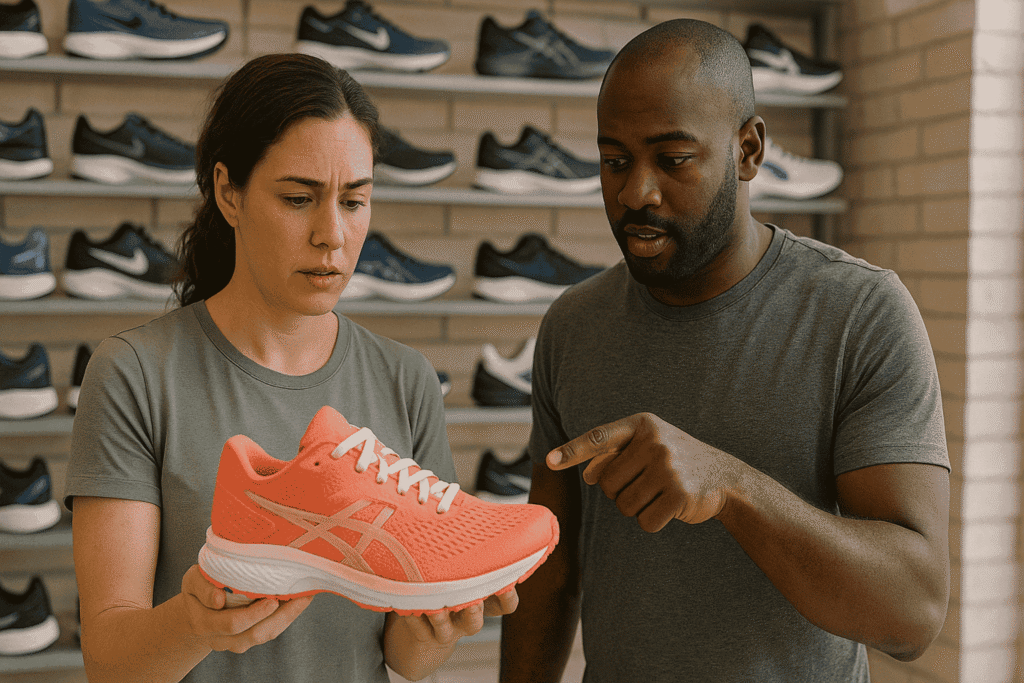
If you are beginning your running journey, one of the biggest early questions is: How to Choose Your First Running Shoes?
Scroll through any running forum and you’ll find endless suggestions:
“Go for Nike Pegasus!”
“Adidas Ultraboost is king!”
“Bro, any cheap shoe works the same.”
No wonder beginners feel completely confused.
Running shoes are expensive, budgets matter, and the fear of picking the wrong pair is real. The truth is simple: there is no universal “best” shoe. There is only the shoe that fits your feet, your budget, and your goals.
This expanded guide breaks down exactly how to choose your first running shoes, explains beginner mistakes, and helps you avoid injuries, wasted money, and confusion.
When you’re figuring out how to choose your first running shoes, the most important element is fit. Comfort, technology, brand—none of these matter if the shoe doesn’t fit your foot correctly.
Your running shoe should feel snug around the heel and midfoot, with a thumb’s width of space between your toes and the front of the shoe.
Why this matters:
Your feet swell when you run.
Running downhill causes your foot to slide forward.
Too little room leads to blisters, black toenails, and toe pain.
Buying the same size as your casual sneakers. Running shoes usually need half to one size bigger, especially if you want to avoid bruised nails.
In a shop, slightly tight shoes may feel “normal.” But go out for a real run—especially on inclines—and suddenly the toes slam into the front, causing pain or numbness.
Try your shoes in the evening when your feet are at their biggest. Jog around inside the store. If you have an incline or ramp, try running down it. Your shoe should feel secure but never squeeze your toes.
When learning how to choose your first running shoes, understand this golden rule: if your toes hit the front, it’s the wrong size. Period.
A big myth in the world of running gear is that expensive or popular shoes are automatically better. Not true.
When understanding how to choose your first running shoes, remember this:
Your shoe should feel comfortable the moment you put it on.
Choosing a shoe because it is trending on Instagram, or because your favorite athlete wears it. Pro runners choose shoes for speed, not beginner comfort.
Thinking discomfort will “break in” over time. Unlike leather boots, modern running shoes don’t require break-in. If they feel wrong at the store, they’ll feel worse on a 5 km run.
Trust your body. If the shoe doesn’t feel right in the first minute, don’t buy it—even if it’s on sale.
When asking how to choose your first running shoes, remember that comfort is your number one guide.
This step is crucial. Do not buy running shoes online unless you have already tried the exact model and size in person.
Brands fit differently:
Nike sizing ≠ Puma sizing
Adidas ≠ Asics
Skechers ≠ New Balance
If you skip a try-on, you won’t know whether:
the shoe pinches your toes
the heel slips
the midfoot rubs
the cushioning feels unstable
Flashy online discounts. Or a friend saying, “Bro, this shoe is perfect for everyone!”
No shoe is perfect for everyone. That’s why learning how to choose your first running shoes requires real testing.
Visit a store, test the exact model, jog a little, then order online if you want to save money. But never skip the testing phase.
Unfortunately, the market is overflowing with fake running shoes—especially in countries where “first copy” products are common.
These fake shoes:
look identical
feel fine during a short walk
but completely fail during a run
The cushioning, midsole foam, and stability mechanisms are nowhere close to the real versions.
If you’re learning how to choose your first running shoes, one rule stands out:
Never buy from unknown sellers or shady Instagram pages.
Only buy from:
brand stores
authorized retailers
official websites
Saving a little money on a fake shoe often leads to injury—and then medical bills cost more.
Pronation means how your foot rolls when it hits the ground.
Neutral: Most beginners fall here. Standard running shoes are fine.
Overpronation: Foot rolls inward a lot. Slight stability shoes may help.
Underpronation (Supination): Foot rolls outward. Flexible cushioning is better.
But here’s the truth:
Many beginners obsess over pronation far more than necessary.
If you want to learn how to choose your first running shoes without getting overwhelmed, keep it simple.
Watching 20 YouTube videos trying to analyze gait frame-by-frame.
If you are unsure, choose a neutral shoe. Or ask the store staff to quickly check your gait. Most good stores have a treadmill for this.
Where do you run most?
Road running: cushioned, lightweight daily trainers
Trail running: grippy, rugged shoes
Gym + Running mix: versatile trainers
Buying rugged trail shoes just because they “look cool” even though you run only on roads.
Trail shoes on roads feel stiff and can make your legs tired quickly.
When learning how to choose your first running shoes, understand your running surface. Pick what feels natural—not too soft, not too firm.
Good running shoes cost money, but you don’t need the most expensive pair.
Mid-range models (₹4,000–₹7,000).
Previous-year models often sell at 30–50% discount and perform almost the same. Brands update colors and names more often than they update technology.
Thinking “cheap shoes are fine for short runs.”
Even a 2 km run can cause injuries if the shoe lacks cushioning or support.
Spend wisely. Save money on T-shirts and accessories. Put your real investment into the shoe.
Understanding how to choose your first running shoes is also about understanding where to put your money.
Never buy a shoe without testing movement.
Jog inside the store.
Do a few hops.
Try a short sprint.
Salespeople are used to it—no need to be shy.
Ordering blindly online because “returns are easy.” Yes, you can return them, but wasted time and effort are a huge downside.
When learning how to choose your first running shoes, movement testing is essential. Standing still tells you nothing.
As you continue to understand how to choose your first running shoes, avoid these:
Buying based on looks or brand
Picking the wrong size
Skipping the try-on
Falling for fake shoes
Using one shoe for all activities
Thinking expensive = better
Here’s a secret many beginners don’t realize: your first running shoe doesn’t need to be perfect. It only needs to keep you injury-free while you start building your running habit.
As you gain experience, you’ll naturally understand whether you prefer:
softer or firmer cushioning
high or low drop
lightweight or stable shoes
Don’t get stuck in decision paralysis. Learn the basics of how to choose your first running shoes, try a few pairs, trust your comfort, and pick the one that feels good in motion.
Your running journey starts with that first comfortable, safe pair.
When figuring out how to choose your first running shoes, size is the most important factor. Your running shoe should be half to one size larger than your casual shoes because your feet swell during runs. Always leave a thumb’s width of space at the front. Try both shoes on, jog in them, and pick the size where your toes never touch the front.
No. Learning how to choose your first running shoes means understanding that comfort matters more than price. Many mid-range models offer excellent cushioning and durability. Beginners benefit far more from a shoe that fits well than from expensive technology meant for elite athletes.
Pronation matters, but you don’t need to obsess over it when deciding how to choose your first running shoes. Most new runners fall into the neutral category. If unsure, pick a neutral shoe or ask a store expert to do a quick gait check. Overthinking pronation usually leads to confusion.
Ideally, three to five pairs. Learning how to choose your first running shoes involves comparing cushioning, fit, width, and stability. Trying multiple options helps you understand what your feet naturally prefer. Don’t rush the decision.
Your running surface is a key part of how to choose your first running shoes. Road runners need lightweight cushioned shoes, while trail runners need grip and protection. If you mix gym and running, choose a versatile daily trainer that supports both activities.
Gym shoes are designed for lateral movement, not forward running motion. If you’re learning how to choose your first running shoes, avoid using flat gym trainers for outdoor runs. They lack cushioning, which can cause shin pain and knee discomfort.
Most good running shoes last 500–800 km. Knowing this helps you plan when learning how to choose your first running shoes. Heavier runners or those running on rough surfaces may see faster wear. Track mileage to avoid injuries from worn-out shoes.
Shoe weight matters less for beginners than comfort and cushioning. When studying how to choose your first running shoes, understand that slightly heavier shoes often provide better durability and support. Super-light shoes are usually designed for racing, not daily training.
Absolutely. Previous-year models are great value when learning how to choose your first running shoes. Brands often release new colorways rather than major performance upgrades. Older models can save you 30-50% without compromising quality.
The biggest mistake is buying based on brand hype instead of personal fit. When learning how to choose your first running shoes, always prioritize comfort and proper testing. Ignore what works for others—your feet are unique, and your running shoe must match them.

Every step forward deserves a high-five.✋
Address:
Plot 21 Krishnapuram Beside Income Tax Colony Rd No 10 Banjara Hills, Hyderabad, 500034, India
Write to us at:





