
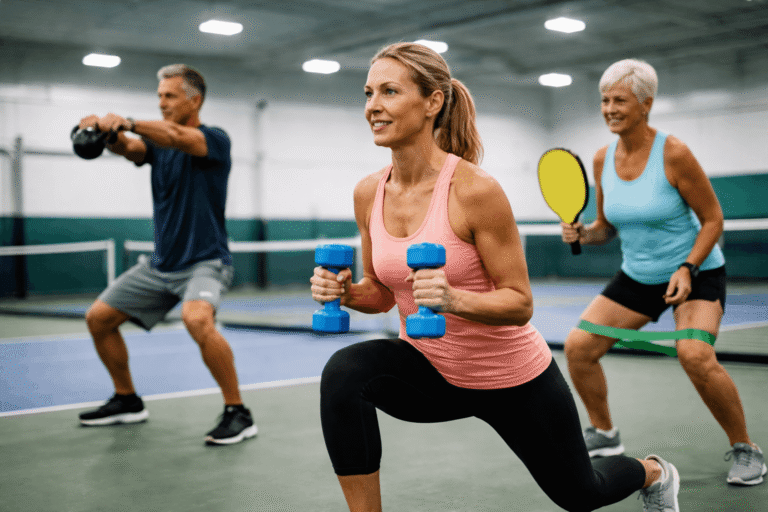
Many pickleball players go to the gym.
They lift weights.
They use cardio machines.
They stretch occasionally.
But when they step on the court, they still feel slow.
They lose balance during fast exchanges.
Their knees ache after long matches.
Why?
Because general fitness and sport-specific performance are not the same thing.
Running on a treadmill doesn’t prepare you for lateral shuffles.
Heavy bench presses don’t protect your shoulder from repetitive paddle swings.
Basic crunches don’t build rotational control.
That’s where Pickleball Fitness Training makes the difference.
Instead of training randomly, you train for the actual demands of the sport — short bursts of speed, quick reactions, lateral movement, rotational control, and joint stability.
When you commit to structured Pickleball Fitness Training, you move better, recover faster, and reduce injury risk. Let’s break down exactly what that looks like.
Your legs are your engine.
Every shuffle, lunge, and recovery step starts from the ground up.
In pickleball, you constantly:
Shift weight side to side
Explode forward to the kitchen
Recover after wide shots
Stay low during dinks
Weak glutes and quads cause:
Poor balance
Slower reactions
Increased knee strain
1. Squats
Build overall leg strength and improve stability.
2. Reverse Lunges
Strengthen quads and glutes while protecting knees.
3. Lateral Lunges
Train side-to-side power — crucial for pickleball.
4. Calf Raises
Support quick push-offs and protect Achilles tendons.
3 sets of 8–12 reps per exercise
Focus on controlled movement
Keep knees aligned over toes
A strong lower body is the foundation of effective Pickleball Fitness Training. Without it, speed and stability suffer.
Most players think power comes from the arm.
It doesn’t.
Power and control come from the core.
Your core:
Transfers force from legs to paddle
Maintains balance during lunges
Protects your lower back
Improves shot accuracy
Weak core muscles lead to:
Inconsistent shots
Back pain
Reduced control during fast rallies
1. Planks (Front & Side)
Improve stability and endurance.
2. Dead Bugs
Strengthen deep core muscles safely.
3. Russian Twists
Train rotational control.
4. Pallof Press
Enhances anti-rotation strength — crucial for stability.
In structured Pickleball Fitness Training, the goal is stability first, rotation second, power third.
A stable core makes your shots cleaner and more controlled.
Pickleball might look low impact, but repetitive paddle swings can strain shoulders and elbows.
Many players develop:
Tendon irritation
Rotator cuff discomfort
Tennis elbow symptoms
Overuse
Weak stabilizing muscles
Poor warm-up
Excessive wrist flicking
1. Resistance Band External Rotations
Strengthen rotator cuff muscles.
2. Scapular Retractions
Improve shoulder blade stability.
3. Wrist Flexor & Extensor Strengthening
Protect elbows from strain.
4. Light Dumbbell Raises (Front & Side)
Build endurance, not bulk.
Perform shoulder activation exercises before playing, not after.
Upper-body care is a vital part of comprehensive Pickleball Fitness Training, especially for players who compete multiple times per week.
Pickleball isn’t about long-distance running.
It’s about quick bursts and fast reactions.
Short lateral shuffles
Fast kitchen exchanges
Sudden directional changes
Quick recoveries
Traditional cardio doesn’t train this.
1. Ladder Drills
Improve foot speed and coordination.
2. Cone Shuffle Drills
Train lateral quickness.
3. Reaction Ball Drops
Enhance hand-eye speed.
4. Partner Mirror Drill
One partner moves; the other mirrors.
Speed without control leads to injury. In Pickleball Fitness Training, agility work should be sharp but controlled.
Here’s a simple 4-day structure:
Squats
Reverse Lunges
Lateral Lunges
Calf Raises
Planks
Ladder Drills
Cone Shuffles
Russian Twists
Pallof Press
Band Rotations
Scapular Retractions
Light Dumbbell Raises
Wrist Strength Exercises
Bodyweight Squats
Side Shuffles
Medicine Ball Rotations
Plank Variations
Keep sessions 30–45 minutes.
Consistency matters more than intensity.
A structured schedule like this turns random gym sessions into focused Pickleball Fitness Training.
| Attribute | General Fitness Training | Pickleball Fitness Training |
|---|---|---|
| Focus | Overall health | Sport performance |
| Movement Type | Linear (forward/back) | Multi-directional |
| Core Training | Basic abs work | Rotational stability |
| Leg Work | Machines & basic lifts | Lateral & functional |
| Shoulder Work | Strength-focused | Stability-focused |
| Injury Prevention | Indirect | Direct & targeted |
| Reaction Training | Minimal | High priority |
| Transfer to Court | Limited | High |
| Balance Training | Often ignored | Integrated |
| Recovery Strategy | General stretching | Sport-specific mobility |
This comparison highlights why generic workouts don’t fully prepare players for competition.
Warm up dynamically before every session.
Train movement patterns, not just muscles.
Focus on quality over heavy weight.
Rest at least one full day per week.
Stretch hips and calves after sessions.
When done consistently, Pickleball Fitness Training improves not just performance but longevity.
Lifting too heavy with poor form
Ignoring mobility
Skipping warm-ups
Training only upper body
Avoiding lateral movements
Overtraining without rest
Copying workouts from unrelated sports
Remember, pickleball requires balance, agility, and stability more than brute strength.
General gym workouts are not enough for peak performance.
Strong legs improve balance and speed.
Core stability enhances control and power transfer.
Shoulder work prevents overuse injuries.
Agility drills sharpen reaction time.
Structured Pickleball Fitness Training leads to better performance and fewer injuries.
If you want to move faster, feel stronger, and stay pain-free, make your training specific.
2–4 times per week is ideal. Even short sessions improve strength and agility. Consistency matters more than long workouts.
Yes. Start with bodyweight exercises and focus on form. Gradually increase resistance over time.
No. Moderate resistance with good technique builds functional strength without increasing injury risk.
Glutes and core are foundational. They control balance, movement, and power transfer.
Strengthen forearms and shoulder stabilizers. Avoid excessive wrist flicking and warm up properly.
Yes, but it should include short bursts and interval training rather than steady-state jogging only.
Yes. Ladder drills and agility exercises improve neuromuscular coordination and speed.
Absolutely. Strength training improves bone density, joint support, and injury prevention.
Most players notice better balance and less fatigue within 3–4 weeks of consistent training.
Stretching helps, but strength and stability training are more important for long-term protection.


Every step forward deserves a high-five.✋
Address:
Plot 21 Krishnapuram Beside Income Tax Colony Rd No 10 Banjara Hills, Hyderabad, 500034, India
Write to us at:





