
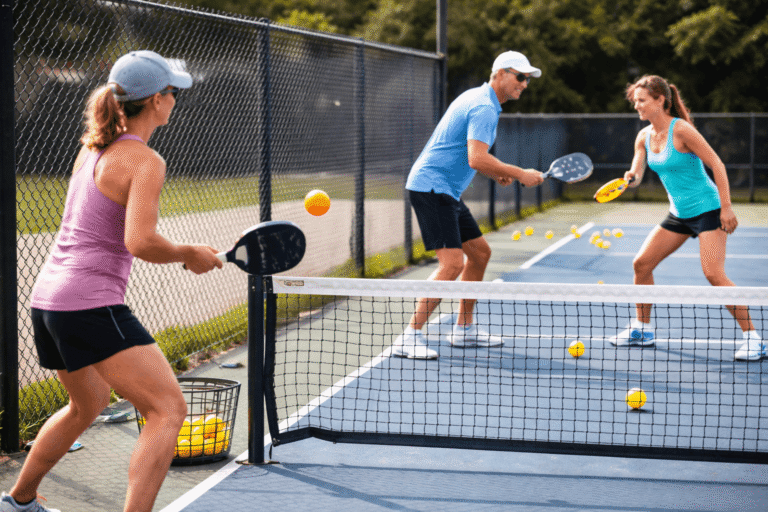
Most beginners think improvement comes from simply playing more games.
They show up.
They rally.
They compete.
They go home.
But weeks later, nothing changes.
Here’s the truth: games test your skills — they don’t build them.
If you want to improve quickly, you need structured repetition. That’s where Pickleball Drills for Beginners make all the difference. Drills isolate specific skills, force repetition, and correct mistakes before they become habits.
When you only play games:
You avoid weak shots.
You repeat bad technique.
You focus on winning instead of learning.
When you practice with purpose using Pickleball Drills for Beginners, your improvement accelerates dramatically.
Let’s break down the most effective drills you can start using today.
You don’t always need a partner to improve. A simple wall can become your best training tool.
Wall drills improve:
Hand-eye coordination
Reaction speed
Paddle control
Shot consistency
The constant rebound forces quick adjustments. You get dozens of reps in minutes.
Stand 6–8 feet from a wall.
Hit controlled forehands against the wall.
Switch to backhands after 20 reps.
Focus on soft, controlled contact.
Keep your knees slightly bent and paddle up.
Stand closer to the wall and volley continuously without letting the ball drop. This simulates fast kitchen exchanges.
Don’t hit hard. Focus on control. Many beginners try to overpower the ball, which defeats the purpose of the drill.
Wall training is one of the simplest and most effective Pickleball Drills for Beginners because it builds muscle memory quickly.
If you want to win more points, master the dink.
The dink is a soft shot that lands in your opponent’s kitchen. It forces patience and control.
Both players stand at the kitchen line.
Dink cross-court only.
Keep the ball low and controlled.
Aim for 20 consecutive shots without error.
Cross-court dinks give you more margin because of the longer diagonal distance.
Add movement:
One player moves left and right.
The other aims for their feet.
This improves touch and positioning.
In beginner games, most points are lost from unforced errors. Dink consistency reduces those errors significantly.
Among all Pickleball Drills for Beginners, this one produces the fastest competitive improvement.
The third shot drop is one of the most important shots in pickleball.
It happens after:
Serve
Return
Your third shot
Instead of driving the ball hard, you drop it softly into the kitchen to move forward.
Start at the baseline.
Partner stands at kitchen line.
Hit a soft drop shot that arcs over the net.
Move forward after contact.
Repeat 15–20 times.
Use a smooth swing.
Avoid flicking the wrist.
Aim high over the net with a soft landing.
Beginners hit too hard. The ball sails long. The key is arc, not speed.
Consistent third shot drops are what separate casual players from competitive ones. That’s why they’re essential in structured Pickleball Drills for Beginners.
Many beginners underestimate the serve and return.
While the serve is underhand and simple, consistency matters.
Place cones or targets deep in the service box.
Hit 20 serves aiming deep.
Track how many land in.
Focus on height and depth.
Depth pushes opponents back and creates easier third shots.
For returns:
Aim high and deep.
Practice recovering quickly to the kitchen.
The return should give you time to move forward.
Reliable serve and return patterns build confidence and reduce pressure during games.
Good shots mean nothing without good movement.
Footwork drills improve:
Balance
Speed
Reaction
Injury prevention
One foot in each square
Side shuffle through ladder
In-and-out quick steps
Lateral crossover steps
Perform each pattern for 30 seconds.
Most beginners reach instead of stepping. This leads to poor balance and inconsistent contact.
Adding ladder work to your weekly routine strengthens your overall athletic foundation and complements your Pickleball Drills for Beginners.
| Attribute | Game Play Only | Structured Practice (Drills) |
|---|---|---|
| Repetition | Random | Focused and repetitive |
| Skill Development | Slow | Fast |
| Error Correction | Rare | Immediate |
| Confidence Building | Inconsistent | Steady growth |
| Shot Variety | Limited to game situations | Isolated skill focus |
| Pressure Level | High | Controlled |
| Movement Practice | Reactive only | Intentional |
| Serve Practice | Limited reps | Dozens of repetitions |
| Dink Consistency | Unstructured | Target-based |
| Improvement Speed | Gradual | Accelerated |
This comparison shows why relying only on games limits growth. Structured Pickleball Drills for Beginners dramatically increase improvement speed.
Practice 20–30 minutes before playing games.
Track your drill consistency numbers weekly.
Focus on one skill per session.
Record yourself to spot technique flaws.
End practice with game simulation drills.
Consistency beats intensity. Even short, focused sessions using Pickleball Drills for Beginners produce noticeable results within weeks.
Practicing without a clear goal
Hitting every shot hard
Ignoring footwork
Skipping warm-ups
Practicing only strengths
Not tracking progress
Avoiding third shot drop reps
Playing too many games, not enough drills
Avoiding these mistakes keeps improvement steady and sustainable.
Playing games alone won’t maximize improvement.
Solo wall drills build reaction and control.
Dinking and third shot drops are essential skills.
Serve and return consistency create scoring opportunities.
Footwork drills prevent injury and improve positioning.
The fastest way to improve is structured repetition. That’s the power of well-designed Pickleball Drills for Beginners.
Ideally, 2–3 times per week. Even 20–30 minutes of focused drilling before games improves consistency quickly. Short, regular practice sessions are better than occasional long ones.
Yes. Wall drills and footwork exercises are highly effective. Solo training builds coordination, timing, and paddle control.
The dinking consistency drill. It reduces unforced errors and builds patience, which wins more points at beginner levels.
Aim for 20–40 repetitions per session. Focus on arc and control rather than speed.
They’re not mandatory, but they improve balance, agility, and injury prevention, which directly supports skill execution.
No. Control and placement matter more than power. Power develops naturally over time.
With consistent drilling, most beginners notice improvement within 2–4 weeks.
Yes. Balance drills with fun gameplay. Keep sessions focused but enjoyable.
Playing too many games and not enough structured practice.
Absolutely. Structured repetition builds muscle memory, reduces errors, and increases confidence much faster than random gameplay.


Every step forward deserves a high-five.✋
Address:
Plot 21 Krishnapuram Beside Income Tax Colony Rd No 10 Banjara Hills, Hyderabad, 500034, India
Write to us at:





