
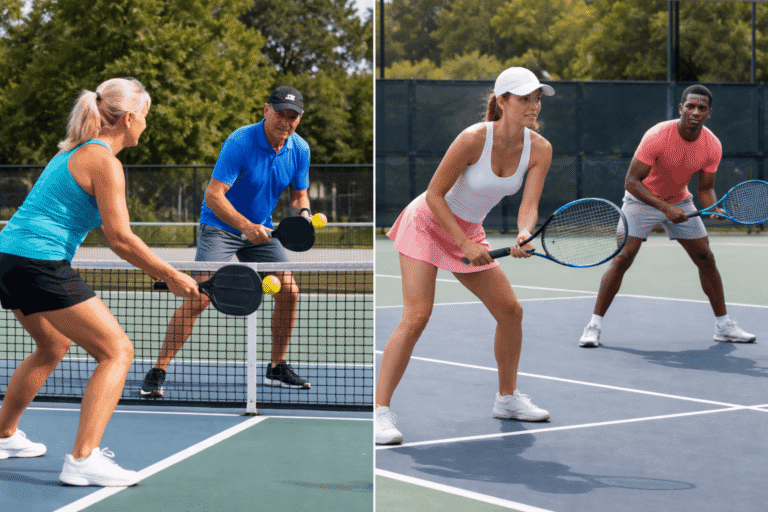
Over the last few years, one conversation has dominated recreational courts across the country: Pickleball vs Tennis. More tennis players are trying pickleball, and many are even making the switch permanently.
But why?
Some say pickleball is easier on the body. Others love the social aspect. Many appreciate that it’s quicker to learn and less physically demanding over long sessions. At the same time, tennis remains a globally respected sport with deeper tradition, greater power, and higher athletic intensity.
If you’re curious about Pickleball vs Tennis, this guide will break down the key differences in rules, court size, scoring, movement, learning curve, and injury risk. Whether you’re a lifelong tennis player or someone choosing between the two, this comparison will help you understand what truly separates these sports.
The first noticeable difference in Pickleball vs Tennis is the playing area and equipment.
Pickleball court: 20 feet wide × 44 feet long
Tennis court (singles): 27 feet wide × 78 feet long
A pickleball court is significantly smaller—about one-third the size of a tennis court. This directly impacts movement, strategy, and physical strain.
Pickleball net: 36 inches at sidelines, 34 inches in the center
Tennis net: 42 inches at posts, 36 inches in the center
The lower net in pickleball encourages more controlled, softer shots, especially around the net area.
Pickleball: Solid paddle (no strings) and plastic ball with holes
Tennis: Strung racket and pressurized felt-covered ball
Pickleball paddles are shorter and lighter. The plastic ball travels slower and produces less bounce compared to a tennis ball.
Smaller court + lighter equipment = less running and lower impact. This is one major reason older athletes and recreational players prefer pickleball.
Scoring is one of the most confusing differences when discussing Pickleball vs Tennis.
Points: 15, 30, 40, game
Must win by two points
Sets usually go to 6 games
Matches typically best of 3 or 5 sets
Tennis scoring has tradition but can feel complicated to beginners.
Games usually played to 11 points
Must win by 2
Only the serving team scores points
Matches often best of 3 games
Pickleball games move quickly and are easier to understand once you learn the basics.
Pickleball has a non-volley zone called “the kitchen” near the net. Players cannot volley (hit in the air) while standing inside this zone. This rule dramatically changes net play strategy compared to tennis.
If you’re transitioning from tennis, spend time mastering kitchen control. Winning in pickleball often depends on soft net play rather than power.
When comparing Pickleball vs Tennis, physical demands are often the biggest deciding factor.
Tennis requires:
Full-court sprints
Lateral slides
Powerful serves
Long rallies
High aerobic capacity
Matches can last 2–4 hours at competitive levels. Tennis stresses the shoulders, knees, ankles, and lower back significantly.
Pickleball emphasizes:
Short lateral movements
Quick reflexes
Hand-eye coordination
Fast net exchanges
Because the court is smaller, players rarely sprint long distances. Games are shorter, and rallies are often built around controlled placement.
Tennis relies heavily on anaerobic bursts + aerobic recovery.
Pickleball relies more on agility and reaction speed than pure endurance.
Tennis is generally more physically demanding overall, but pickleball still offers an excellent cardiovascular workout—just at lower intensity.
Another major reason for the popularity surge in pickleball comes down to accessibility.
Requires mastering serves early
Larger court increases difficulty
Harder to sustain rallies as a beginner
Technical stroke mechanics take time
Beginners often struggle to rally consistently in tennis without lessons.
Underhand serve
Smaller court
Slower ball speed
Easier to maintain rallies quickly
Many beginners can enjoy competitive rallies within their first session.
Tennis players often try to overpower the ball in pickleball. This usually leads to unforced errors. Placement matters more than power.
Injury risk is a big factor in the debate around Pickleball vs Tennis.
Tennis elbow
Rotator cuff strain
Knee tendonitis
Ankle sprains
Lower back strain
The high-impact movements and overhead serving increase stress on joints.
Calf strains
Achilles injuries
Wrist strain
Occasional ankle twists
While pickleball is lower impact, sudden quick movements can still cause injury—especially for older players.
Tennis carries higher overall impact stress. Pickleball reduces load but still requires proper warm-ups and mobility work.
| Attribute | Pickleball | Tennis |
|---|---|---|
| Court Size | 20×44 feet | 27×78 feet |
| Equipment | Solid paddle, plastic ball | Strung racket, felt ball |
| Net Height | 34–36 inches | 36–42 inches |
| Scoring System | To 11, serve-only scoring | 15-30-40 system |
| Match Length | 20–45 minutes typical | 1–4+ hours |
| Physical Intensity | Moderate | High |
| Learning Curve | Quick for beginners | Steeper |
| Common Injuries | Calf/Achilles strains | Elbow, shoulder, knee |
| Power vs Control | Control-focused | Power + spin-focused |
| Social Accessibility | Highly social, doubles dominant | Singles & competitive tradition |
If you’re moving from tennis to pickleball, here’s what to focus on:
Pickleball rewards compact strokes. Big tennis swings create errors.
Dinks (soft shots into the kitchen) win points more often than power drives.
Unlike tennis baseline rallies, pickleball strategy favors positioning near the non-volley zone.
While spin helps, placement is more important than heavy topspin.
Pickleball is doubles-heavy. Clear communication prevents confusion and open-court gaps.
Overhitting every ball
Ignoring the kitchen rule
Standing too far back
Using tennis footwork patterns exclusively
Underestimating reaction speed needed at the net
Many tennis players initially struggle because they rely on power instead of strategy.
Pickleball is easier to learn and less physically demanding.
Tennis offers higher intensity and greater endurance challenge.
Injury risk is generally lower in pickleball but not zero.
Strategy differs greatly—power in tennis, control in pickleball.
Both sports provide excellent cardiovascular and coordination benefits.
The debate around Pickleball vs Tennis isn’t about which sport is better. It’s about which fits your goals, fitness level, and lifestyle.
For most beginners, yes. Pickleball has a smaller court, slower ball, and underhand serve, making it easier to rally quickly. However, advanced pickleball strategy can still be highly competitive and technical.
Tennis generally burns more calories due to longer court coverage and higher intensity rallies. Singles tennis especially demands more sprinting and endurance compared to doubles pickleball.
Yes, but adjustments are necessary. Tennis players must shorten their swings, reduce power, and adapt to the kitchen rule. Strategic control replaces baseline power play.
Pickleball is lower impact than tennis, which makes it attractive for older adults. However, sudden directional changes can still cause calf or Achilles injuries if players don’t warm up properly.
It’s easier to learn, requires less space, and promotes social doubles play. Communities can convert one tennis court into multiple pickleball courts, increasing accessibility.
Many professionals acknowledge pickleball’s growth. Some even compete in exhibition matches. However, tennis remains more physically demanding at elite levels.
Both are excellent. Tennis offers greater cardiovascular intensity, while pickleball promotes sustainable, consistent activity for a broader age range.
No. While popular among older adults, younger athletes are increasingly playing competitively. The sport now has professional tours and growing youth participation.
Most beginners can rally comfortably within a few sessions. Competitive skill, especially at higher levels, may take months or years of consistent play and strategic learning.
Not necessarily. Many athletes play both. Your choice depends on your goals—competitive endurance and power (tennis) or social, strategic, lower-impact play (pickleball).


Every step forward deserves a high-five.✋
Address:
Plot 21 Krishnapuram Beside Income Tax Colony Rd No 10 Banjara Hills, Hyderabad, 500034, India
Write to us at:





