
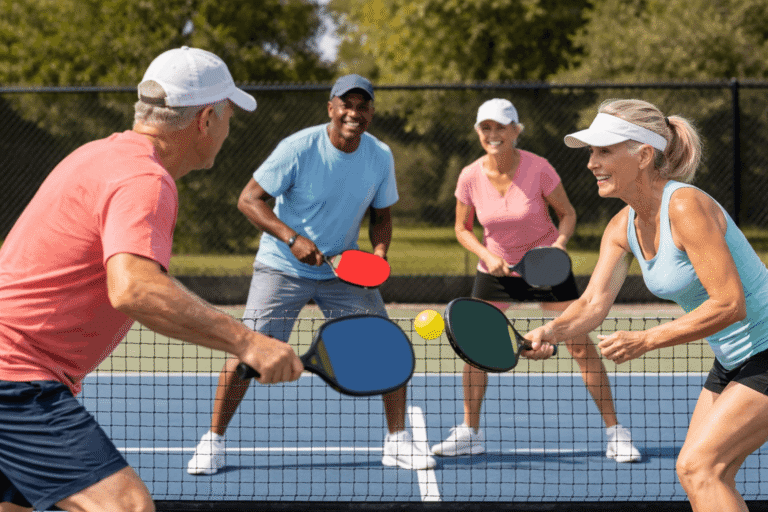
Pickleball is not a power game. It’s a smart game.
Many new players think the hardest hitter wins. But after just a few matches, they realize something surprising: the player who controls the court usually wins. That’s why understanding Pickleball Strategy for Beginners is more important than learning to smash the ball harder.
If you are just starting out, this guide will show you how to win more points by thinking smarter, positioning better, and choosing the right shots. You don’t need elite athleticism. You need good decisions.
Let’s break it down step by step.
Good positioning is the foundation of strong Pickleball Strategy for Beginners. If you stand in the wrong place, even perfect shots won’t save you.
The non-volley zone (also called the kitchen) is the most important area on the court.
After serving and returning, both teams should move forward and aim to reach the non-volley zone line. Why?
It shortens your opponent’s reaction time.
It gives you better angles.
It reduces open space behind you.
It allows controlled volleys.
If you stay back near the baseline, you give your opponent more time and more options. At the kitchen line, you take control of the rally.
In smart Pickleball Strategy for Beginners, getting to the kitchen line safely is often more important than hitting a winner.
The area between the baseline and kitchen line is called the transition zone. It’s also known as “no man’s land.”
This is where many beginners lose points.
Common mistakes:
Running forward without balance
Hitting hard drives while moving
Staying stuck halfway
Instead, move forward gradually. Split step. Stay balanced. Use softer shots to approach the line safely.
When moving forward, pause after each shot. Regain balance before hitting again. Controlled movement wins more points than rushed footwork.
One of the most important elements of Pickleball Strategy for Beginners is understanding the third shot drop.
Serve (Shot 1)
Return (Shot 2)
Third shot by the serving team
The serving team starts at a disadvantage because they must let the return bounce. The goal of the third shot is simple:
Hit a soft, controlled shot that lands in your opponent’s kitchen so you can move forward safely.
Use the third shot drop when:
Your opponents are already at the kitchen line.
You are still near the baseline.
You need time to move forward.
Why it works:
It forces your opponent to hit upward.
It slows the game down.
It allows you to neutralize aggressive players.
Beginners often try to hit a hard third shot drive. Sometimes it works. But more often, it comes back even faster.
In smart Pickleball Strategy for Beginners, the third shot drop is about patience, not power.
Dinking is where matches are truly won.
A dink is a soft shot that lands in the opponent’s non-volley zone. It forces control and patience.
Many beginners get bored during dinking rallies. They rush. They try to speed it up too soon. That’s when mistakes happen.
Strong Pickleball Strategy for Beginners teaches you to embrace the dink rally.
Both have value.
Travel over the lower part of the net.
Give you more margin for error.
Move your opponent wider.
Create better angles.
Cross-court dinks are safer and more strategic for beginners.
Travel a shorter distance.
Apply pressure faster.
Can surprise your opponent.
However, they leave less room for error.
Start cross-court. Build consistency. Speed up only when you see a high ball.
Every opponent plays differently. Good Pickleball Strategy for Beginners means adjusting your approach.
These players try to hit hard drives and speed-ups.
How to beat them:
Keep balls low.
Dink patiently.
Avoid giving high bounce shots.
Let them make mistakes.
Aggressive players often lose patience first.
These players love hitting high, deep lobs.
How to respond:
Stay ready for overheads.
Don’t crowd the kitchen too tightly.
Communicate clearly in doubles.
Hit overheads deep and controlled.
Avoid smashing every overhead wildly. Placement matters more than force.
Bangers hit hard drives almost every time.
Strategy against them:
Block softly into the kitchen.
Absorb pace instead of countering with more pace.
Stay relaxed at the net.
The softer your hands, the more uncomfortable they become.
This is where practical Pickleball Strategy for Beginners really shows its value — you don’t fight power with power. You fight power with control.
| Attribute | Power-Based Play | Control-Based Play |
|---|---|---|
| Shot Speed | Fast, aggressive | Moderate to soft |
| Error Rate | Higher | Lower |
| Rally Length | Short | Longer |
| Third Shot | Hard drive | Soft drop |
| Net Play | Speed-ups | Dinks & placement |
| Patience Required | Low | High |
| Success at Beginner Level | Inconsistent | More consistent |
| Physical Demand | Higher explosiveness | More balance & control |
For most new players, control-based play wins more matches. Power can be added later.
Win the net first. Getting to the kitchen line is priority number one.
Keep the ball low. Low balls are hard to attack.
Play high-percentage shots. Don’t aim for lines.
Be patient in dink rallies. Wait for the right ball.
Target the middle in doubles. It creates confusion.
Good Pickleball Strategy for Beginners is about reducing mistakes before trying to hit winners.
Trying to end points too quickly
Standing too far back
Ignoring footwork
Speeding up low balls
Not adjusting to opponent style
Panicking during long rallies
Remember: most points at beginner level are lost, not won.
Strategy beats power in pickleball.
The kitchen line is your best position.
The third shot drop is a game changer.
Dinking is a weapon, not a weakness.
Adjust your game based on your opponent.
Control-based play is more consistent for new players.
If you focus on smart decisions instead of hard hits, your improvement will accelerate.
Also read : “How to Play First Pickleball Game“
The most important strategy is getting to the non-volley zone line and controlling rallies with soft shots. Beginners often focus on power, but smart positioning and patience win more points. Reducing unforced errors should be your first priority before learning advanced shots.
Beginners should learn the third shot drop first. While drives can work occasionally, the drop helps you move safely to the kitchen line and neutralize aggressive opponents. Mastering this shot builds a strong strategic foundation.
Yes. Dinking teaches control, touch, and patience. It forces opponents to hit upward and reduces attack opportunities. Many beginner matches are decided during dink rallies, so it’s a crucial skill to develop early.
Focus on blocking softly and keeping the ball low. Let them generate pace while you absorb it. Hard hitters often make more errors when forced into longer rallies. Stay calm and controlled.
After serving, stay back to hit your third shot, then move forward toward the kitchen line once you hit a drop or controlled shot. Do not rush blindly forward without balance.
Trying to hit winners too early. Most points are lost due to impatience. Smart shot selection and consistency are far more important than power.
With focused practice, players can understand basic strategy in a few weeks. Applying it consistently takes more time and match experience. Playing with better players accelerates learning.
Cross-court dinks are generally safer because the net is lower and the court is longer diagonally. However, mixing in straight dinks keeps opponents guessing. Balance is key.
Absolutely. Many successful players rely on positioning, anticipation, and control rather than strength. Pickleball rewards smart play more than physical dominance.
It’s a combination, but strategy often matters more at beginner and intermediate levels. Players who understand positioning, patience, and shot selection consistently outperform those who rely only on athletic ability.


Every step forward deserves a high-five.✋
Address:
Plot 21 Krishnapuram Beside Income Tax Colony Rd No 10 Banjara Hills, Hyderabad, 500034, India
Write to us at:





