
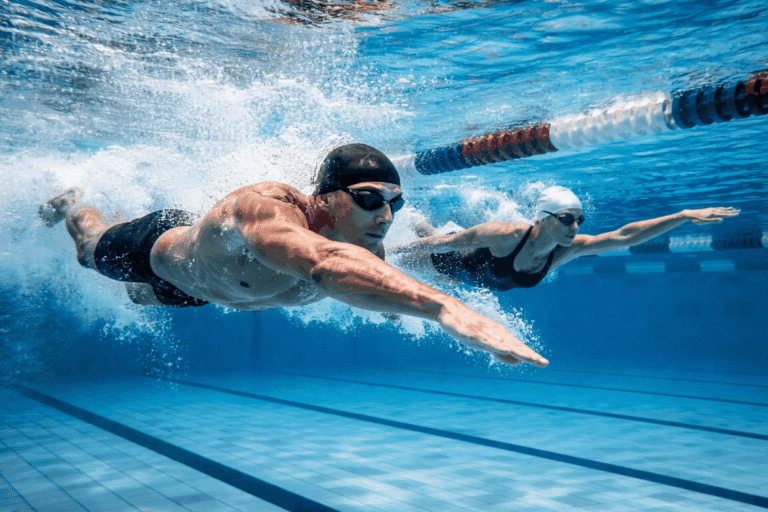
Swimming feels different from any other workout. The moment you step into the water, your body experiences resistance, buoyancy, and pressure — all at the same time. Unlike running or lifting weights, you’re not fighting gravity in the same way. Instead, you’re moving through a dense, supportive environment that changes how your muscles, lungs, and heart respond.
This is where the Science Behind Swimming becomes fascinating. Every stroke you take forces your body to adapt in unique ways. From muscle activation to oxygen efficiency, swimming challenges your system differently than land-based exercise.
Understanding the Science Behind Swimming can help you train smarter, avoid plateaus, and appreciate why swimmers often develop lean muscle, strong lungs, and durable joints.
Let’s break it down in simple, practical terms.
Water is nearly 800 times denser than air. That means every movement you make meets resistance — forward, backward, sideways, and rotationally.
When you lift weights, resistance works mainly against gravity. In swimming, resistance surrounds you. Your arms pull water. Your legs kick against drag. Even small adjustments engage stabilizing muscles.
This constant resistance explains why the Science Behind Swimming shows strong full-body muscle recruitment — even at moderate intensity.
Unlike running (mostly lower body) or cycling (lower body dominant), swimming uses:
Shoulders
Back muscles (lats and traps)
Core stabilizers
Glutes
Hip flexors
Quadriceps and hamstrings
Even your neck and forearm muscles work to maintain alignment and propulsion.
You’re not isolating muscles. You’re coordinating them.
Your core works overtime in the water. To maintain a horizontal position, your abdominal and lower back muscles stay engaged continuously.
In fact, according to the Science Behind Swimming, maintaining body alignment reduces drag and improves efficiency — meaning your core strength directly impacts speed and endurance.
Focus on body alignment before increasing speed. A tight core and straight spine reduce drag and conserve energy.
One of the most powerful elements of the Science Behind Swimming is breathing control.
On land, breathing is automatic and unrestricted. In water, breathing becomes rhythmic and intentional.
Swimmers must coordinate breath with stroke timing. You inhale quickly and exhale slowly underwater. This controlled pattern improves respiratory muscle strength.
Over time, your diaphragm and intercostal muscles become more efficient.
VO2 max refers to the maximum amount of oxygen your body can use during exercise. Swimming challenges this system because:
You can’t breathe whenever you want
Your body works against water resistance
Hydrostatic pressure slightly compresses your chest
These factors increase respiratory demand, improving oxygen delivery efficiency.
Regular swimming enhances lung elasticity and breathing control. Competitive swimmers often show higher lung capacity compared to non-swimmers.
The Science Behind Swimming highlights that this adaptation improves not just sports performance but also overall cardiovascular health.
Holding your breath too long. This increases fatigue and anxiety. Instead, exhale steadily underwater and inhale quickly during rotation.
Swimming builds both cardiovascular endurance and muscular stamina — but in a balanced way.
Because swimming often involves sustained rhythmic movement, it strongly develops aerobic capacity.
Your heart adapts by:
Increasing stroke volume (more blood pumped per beat)
Lowering resting heart rate
Improving circulation efficiency
The Science Behind Swimming shows that even moderate swim sessions can significantly improve cardiovascular markers over time.
Unlike lifting weights, where fatigue can feel sharp and localized, swimming fatigue tends to feel systemic.
Why?
Because:
Muscles work continuously
Oxygen demand is high
Resistance never disappears
This creates endurance rather than explosive overload.
Swimming trains muscles to sustain effort rather than just produce force.
Swimming can burn between 400–700 calories per hour depending on intensity, stroke, and body weight.
But calorie burn is only part of the story.
Here’s how swimming stacks up:
| Attribute | Swimming | Running | Cycling |
|---|---|---|---|
| Impact on Joints | Very Low | High | Low |
| Muscle Engagement | Full Body | Lower Body Dominant | Lower Body Dominant |
| Calorie Burn (avg/hr) | 400–700 | 500–900 | 400–800 |
| Core Activation | High | Moderate | Moderate |
| Injury Risk | Low | Moderate–High | Low–Moderate |
| Cardiovascular Demand | High | High | High |
| Cooling Effect | Natural (water) | Sweat-based | Airflow-based |
| Coordination Requirement | High | Low | Moderate |
The Science Behind Swimming shows that water immersion also helps regulate body temperature, allowing longer sessions without overheating.
Because swimming is joint-friendly, people can train consistently without overuse injuries. Consistency is key to fat loss.
Swimming may burn slightly fewer calories than intense running, but reduced injury risk often means greater long-term adherence.
Alternate slow endurance laps with short sprint intervals to boost metabolic demand.
The real magic of the Science Behind Swimming appears over months and years.
Water buoyancy reduces body weight impact by up to 90%. That means less stress on:
Knees
Ankles
Hips
Lower back
This makes swimming ideal for long-term joint preservation.
Swimming strengthens the posterior chain:
Upper back
Glutes
Core stabilizers
These muscles counteract poor posture from sitting and desk work.
Balanced muscle development reduces imbalances common in single-plane sports like running.
Hydrostatic pressure also aids circulation and recovery.
The Science Behind Swimming confirms that regular swimmers often report fewer chronic joint complaints compared to high-impact athletes.
Water resistance creates full-body muscle engagement.
Controlled breathing improves oxygen efficiency.
Swimming enhances both cardiovascular and muscular endurance.
It provides high calorie burn with low joint stress.
Long-term adaptations include better posture and joint durability.
Understanding the Science Behind Swimming allows you to train intentionally instead of randomly swimming laps.
Swimming combines resistance, breath control, and coordination. Even slow laps require continuous muscle activation. Because water surrounds you, there’s no true rest phase. That constant engagement explains why beginners fatigue quickly despite moderate speed.
Yes, especially lean muscle endurance. While it may not create bodybuilder-sized muscles, the resistance from water stimulates muscle fibers across the entire body. Over time, swimmers develop toned shoulders, strong backs, and stable cores.
Both improve cardiovascular fitness. However, swimming offers similar heart benefits with less joint stress. For individuals with knee or hip concerns, swimming may be more sustainable long-term.
Controlled breathing strengthens respiratory muscles and improves oxygen efficiency. Swimmers learn to exhale fully and inhale quickly, which enhances breathing mechanics over time.
Yes. Swimming burns significant calories and allows frequent training due to low injury risk. Consistency plays a larger role than intensity alone, making swimming effective for gradual fat loss.
Most strokes rely heavily on pulling movements, engaging the latissimus dorsi, deltoids, and rotator cuff muscles. Repeated resistance builds strength and endurance in these areas.
Generally yes. Water buoyancy reduces stress on joints, making swimming one of the safest cardiovascular exercises for arthritis or injury recovery.
Cardiovascular adaptations can begin within 3–4 weeks. Visible muscle tone and endurance improvements typically appear within 6–8 weeks of consistent training.
Yes. It strengthens the upper back and core, which helps counteract rounded shoulders and slouched posture common in sedentary lifestyles.
Because it’s low-impact, adaptable in intensity, and supports joint health, swimming can be maintained well into older age. The physiological benefits continue accumulating without the wear and tear of high-impact sports.


Every step forward deserves a high-five.✋
Address:
Plot 21 Krishnapuram Beside Income Tax Colony Rd No 10 Banjara Hills, Hyderabad, 500034, India
Write to us at:





