
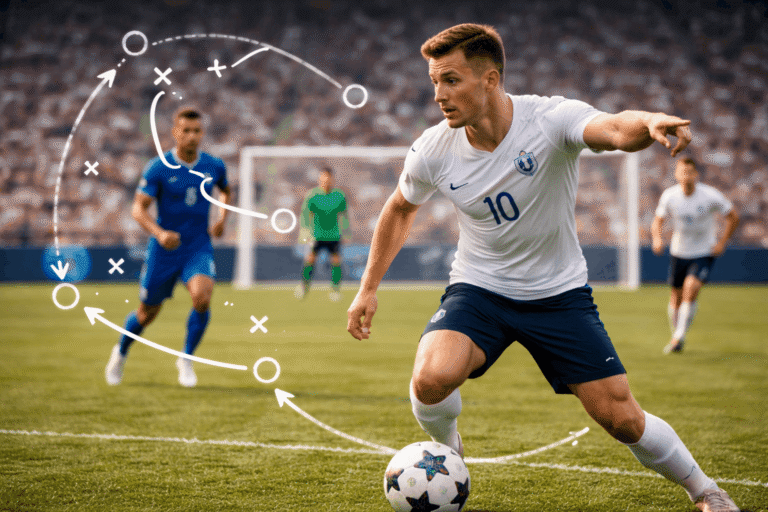
Some players are fast. Some are strong. Some are technically gifted. But the smartest players always seem one step ahead. They move before the pass is played. They intercept without sliding. They create space without sprinting.
That advantage comes from Football IQ.
If you want to play smarter, react quicker, and control the game mentally, you must develop your Football IQ. It is not just about talent. It is about understanding space, timing, and decision-making.
The good news? Intelligence on the pitch can be trained.
Football IQ is your ability to read the game and make smart decisions quickly. It combines awareness, anticipation, and tactical understanding.
Let’s break it down.
Football is a game of seconds. Every touch presents choices:
Pass or dribble?
Shoot or recycle possession?
Press or hold position?
Players with high Football IQ choose the best option under pressure. They do not panic. They stay calm and efficient.
Good decisions reduce mistakes. Great decisions create chances.
Space wins matches.
Spatial awareness means:
Knowing where teammates are.
Knowing where opponents are.
Understanding open areas before receiving the ball.
Elite midfielders check their shoulders constantly. They scan before they receive the ball. That habit alone increases Football IQ significantly.
Anticipation is predicting what will happen next.
Defenders intercept passes before attackers move. Strikers start runs before the through ball is played. This is not luck. It is reading patterns.
The more you understand the game, the stronger your anticipation becomes.
Many players rely only on physical ability. But speed fades. Strength declines. Intelligence remains.
Here is why Football IQ separates levels:
It reduces wasted movement.
It increases efficiency.
It helps you adapt to different opponents.
It improves teamwork.
Two players may have equal skill. The smarter one will always appear better because they choose smarter moments.
Coaches love players who understand shape and positioning. It makes the whole team stronger.
Improving intelligence on the pitch requires active effort. Here are practical ways to develop it.
Do not just follow the ball.
Instead:
Watch off-ball movement.
Observe defensive lines.
Notice pressing triggers.
Study transitions.
Pause games and ask yourself:
“What would I do here?”
Active watching sharpens tactical understanding.
Learn formations like:
4-3-3
4-2-3-1
3-5-2
Understand player roles in each system. When you know tactical structure, your positioning improves automatically.
Reading tactical breakdowns or watching analysis videos builds deeper Football IQ.
Small-sided games (3v3, 4v4, 5v5) force quicker decisions.
Why?
Less space.
Faster transitions.
More touches on the ball.
These games increase reaction speed and improve awareness under pressure.
After matches, reflect:
Why did I lose possession?
Was I out of position?
Did I scan enough?
Self-analysis strengthens learning faster than repetition alone.
Talking increases awareness.
Call for the ball.
Warn teammates of pressure.
Organize shape.
Communication builds leadership and strengthens collective intelligence.
Make shoulder checks a habit.
Scan:
Before the ball arrives.
During movement.
After passing.
Scanning improves decision speed dramatically.
Trying different roles expands understanding.
A defender who plays midfield understands passing lanes better. A striker who plays defense understands marking patterns.
Versatility enhances overall Football IQ.
Train your brain when tired. Decision-making under fatigue mirrors real matches.
Ask coaches for feedback regularly.
Watch professional players in your position only, not just highlights.
Focus on positioning first, then skill.
Small improvements in awareness create massive performance gains.
Many players confuse intelligence with skill. They are related but different.
Technical skill is how well you control and manipulate the ball.
Football IQ is how well you decide what to do with it.
Here is a simple comparison:
| Attribute | Football IQ | Technical Ability |
|---|---|---|
| Trainability | Improves with study & experience | Improves with repetition |
| Match Impact | Controls tempo & positioning | Executes actions |
| Development Speed | Gradual, experience-based | Faster with practice |
| Practice Methods | Tactical study, analysis | Drills, ball mastery |
| Importance by Position | Critical for midfield & defense | Crucial for attackers |
A technically skilled player with low intelligence may lose the ball often. A smart player with average technique can still dominate through positioning.
The best players combine both.
Improving Football IQ requires practical application. Here are drills that help:
Small possession circles improve:
Quick passing
Spatial awareness
Press resistance
Limit touches to increase challenge.
Set up drills where possession changes quickly.
Players must:
React immediately.
Switch from attack to defense.
Recognize shape shifts.
This builds anticipation.
Divide the field into zones. Players must:
Move intelligently between zones.
Create passing angles.
Maintain structure.
These drills force smarter movement.
Coach calls a number or color before the pass. Player must quickly identify the correct teammate.
This improves:
Reaction time
Focus
Awareness
Consistent use of these drills increases match intelligence.
Watching only highlights instead of full matches.
Ignoring defensive positioning.
Playing without scanning.
Focusing only on physical training.
Avoiding these mistakes speeds up improvement.
Intelligence on the pitch is trainable.
Awareness and scanning are essential habits.
Small-sided games accelerate learning.
Decision-making separates levels.
Combine intelligence with technical skill for maximum impact.
Developing Football IQ is a long-term process, but it produces lasting results.
The smartest players make the game look simple. They move early. They pass quickly. They rarely seem rushed.
That is not luck. That is preparation.
Improving Football IQ requires watching, studying, reflecting, and practicing with purpose. It is about understanding patterns, reading space, and making efficient decisions.
When your intelligence improves, the game slows down mentally — even when it speeds up physically.
Think faster. Play smarter. Control the game with your mind.
Yes. While experience plays a role, intelligence on the pitch improves through tactical study, video analysis, and game exposure. Regular reflection and feedback accelerate development significantly.
Players can begin learning game awareness from a young age. Youth players benefit from small-sided games and simple tactical explanations. The earlier the foundation is built, the stronger long-term understanding becomes.
Playing helps, but only if you reflect and analyze. Simply participating without thinking limits growth. Active learning makes the difference.
Midfield roles often demand high intelligence because they connect defense and attack. However, defenders also rely heavily on anticipation and positioning.
Yes. Smart positioning and good decisions can compensate for moderate technical ability. Intelligence often reduces mistakes.
Scanning increases awareness before receiving the ball. It shortens decision time and reduces pressure situations.
Both matter, but intelligence can extend a player’s career and effectiveness. Smart players conserve energy and choose better moments.
After every match if possible. Short reflections immediately after games are most effective while memories are fresh.
Yes. Elite teams use tactical drills, video analysis, and scenario training to improve awareness and reaction speed.
Noticeable changes can appear within weeks if habits like scanning and reflection are practiced consistently. Significant development occurs over months and seasons.

Every step forward deserves a high-five.✋
Address:
Plot 21 Krishnapuram Beside Income Tax Colony Rd No 10 Banjara Hills, Hyderabad, 500034, India
Write to us at:





