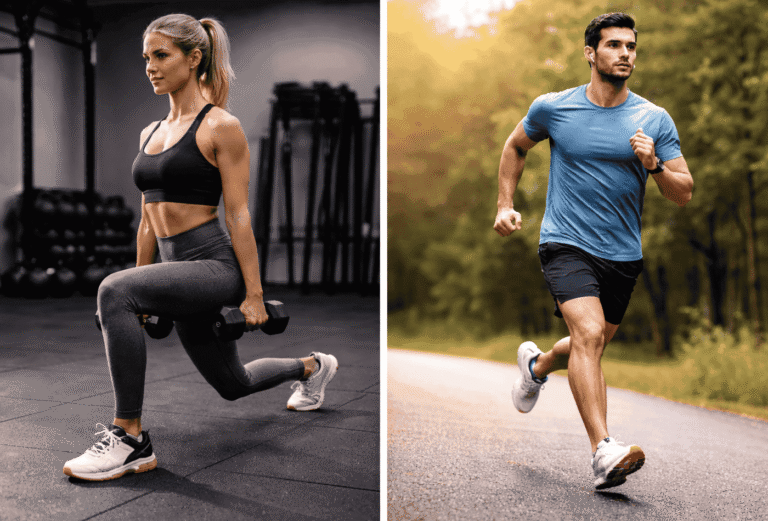
Introduction: Not a Science Test—Just the Truth
This isn’t a lab experiment.
This is real life training.
Drop two shoes from the same height.
One bounces.
One falls flat.
That drop test tells you almost everything you need to know about Gym Shoe Vs. Running Shoe.
Running equals cushion + bounce.
Training equals flat + stable.
Yet every day, people squat, deadlift, and lunge in shoes built to bounce forward—not to stay grounded. If your feet are your foundation, the wrong shoe is like building strength on sand.
This guide breaks down Gym Shoe Vs. Running Shoe in plain language—no fluff, no science overload—just what actually matters when you train.
The Drop Test: Why It Never Lies
The drop test is simple:
Drop a running shoe → it rebounds like a trampoline
Drop a training shoe → it hits the ground and stays there
That bounce is intentional. Running shoes are designed to return energy forward. Training shoes are designed to kill movement.
This single test perfectly shows the real difference in Gym Shoe Vs. Running Shoe design.
Running Shoes Explained (The Bouncy One)
What Running Shoes Are Built For
Running shoes exist for one purpose: forward motion.
They are engineered to:
Absorb repetitive impact
Reduce joint stress
Propel you forward efficiently
Key Features
Thick foam midsoles
Soft cushioning
Curved or rockered sole
Lightweight materials
This is why the Gym Shoe Vs. Running Shoe debate matters—because these features help runners but hurt lifters.
Why Running Shoes Fail in the Gym
When you lift in running shoes:
Your heel compresses under load
Your foot wobbles side-to-side
Power leaks before it hits the floor
On a squat or deadlift, that softness acts like a mattress under your feet.
Common Mistake 🚫
Thinking “comfortable” equals “good for lifting.” Comfort without stability reduces force output.
Training Shoes Explained (The Flat One)
What Training Shoes Are Built For
Training shoes are built for control, not bounce.
They keep your foot stable so your strength transfers directly into the ground.
Key Features
Firm, flat sole
Minimal cushioning
Wide toe base
Strong heel support
This is the other side of Gym Shoe Vs. Running Shoe—stability over softness.
Why Training Shoes Win for Strength
In training shoes:
Your foot stays planted
Balance improves instantly
Power goes straight down, not sideways
This is why serious lifters prioritize training shoes—or go barefoot.
Why Some People Lift Barefoot or in Flat Shoes
Ever notice people squatting barefoot or in flat canvas shoes?
That’s not a trend.
It’s physics.
Barefoot lifting removes cushioning completely. This creates:
Maximum ground contact
Better balance
Stronger force transfer
This barefoot logic exists because of the same Gym Shoe Vs. Running Shoe principle: stability beats softness for strength.
Pro Tip 💡
If barefoot isn’t allowed, flat shoes (training shoes or minimalist styles) give similar benefits.
Gym Shoe Vs. Running Shoe: Side-by-Side Comparison
| Feature | Running Shoe | Training (Gym) Shoe |
|---|---|---|
| Cushioning | Soft, thick | Firm, minimal |
| Sole Shape | Curved / rockered | Flat |
| Stability | Low under load | High |
| Energy Return | High bounce | Zero bounce |
| Best For | Running, jogging | Squats, deadlifts, HIIT |
| Ground Contact | Reduced | Maximum |
| Balance Support | Poor for lifting | Excellent |
| Force Transfer | Leaks power | Direct power |
This table summarizes the Gym Shoe Vs. Running Shoe difference clearly: one moves you forward, the other keeps you grounded.
Why Lifting in Running Shoes Holds You Back
When lifting heavy:
Every rep depends on balance
Every inch of instability steals strength
Running shoes collapse under weight. Training shoes resist it.
If you’ve ever felt:
Wobbly during squats
Unstable on lunges
Weak at the bottom of deadlifts
There’s a good chance the issue isn’t your legs—it’s your shoes. That’s the hidden cost in the Gym Shoe Vs. Running Shoe decision.
When Running Shoes Actually Make Sense
To be clear—running shoes are not bad.
They are perfect for:
Running
Treadmill workouts
Long walks
Cardio-focused sessions
Problems only start when running shoes are used for lifting. That’s where the Gym Shoe Vs. Running Shoe confusion causes mistakes.
Key Takeaway ✅
The shoe should match the movement—not your outfit.
Simple Rule to Remember
Here’s the easiest rule you’ll ever follow:
RUN in running shoes
LIFT in training or flat shoes
That’s the entire Gym Shoe Vs. Running Shoe debate in one sentence.
How the Wrong Shoes Affect Long-Term Progress
Training in unstable shoes doesn’t just hurt performance—it can:
Increase knee stress
Reduce ankle control
Limit strength gains
Over months and years, poor footwear choices compound. Choosing correctly in the Gym Shoe Vs. Running Shoe decision protects both progress and joints.
Final Thoughts: Your Feet Are Your Foundation
Everything starts from the ground up.
If your base is unstable, your strength has a ceiling.
If your shoes absorb force, your muscles can’t produce it fully.
The Gym Shoe Vs. Running Shoe difference isn’t marketing—it’s mechanics.
Choose bounce for miles.
Choose flat for strength.
Your feet will thank you.
 Watch the Reel
A quick drop test shows the truth: running shoes bounce for forward motion, gym shoes stay flat for stability. Run in runners, lift in trainers—your feet are your foundation.