
If you’ve been running consistently—whether training for a 5K or piling up marathon miles—you’ve probably felt that unmistakable sting on the outer part of your knee or thigh. That sharp, nagging sensation is often the calling card of IT Band Syndrome, one of the most frustrating injuries runners face. The good news? With the right approach, you can dramatically reduce pain, speed up healing, and prevent future flare-ups. That’s the heart of IT Band Relief & Prevention: understanding what your body needs and giving it a clear, repeatable plan.
Most runners don’t struggle because they lack discipline—they struggle because they don’t know what to do or when to do it. Should you foam roll before or after you run? Should stretching be a daily thing? How often is strength work required? This expanded guide breaks everything down into two simple, actionable systems:
A weekly IT Band care routine (2–3 times per week)
A run-day routine you’ll follow before and after every run
By the end, you’ll know exactly how to warm up, how to recover, and how to build long-term resilience in your hips and knees. Think of this as your complete roadmap to IT Band Relief & Prevention, designed for real runners who want less pain and more consistent training.
Think of this routine as your base maintenance plan. These sessions aren’t meant to be rushed or crammed in—doing them consistently is what actually keeps your IT band healthy. Each part plays a specific role in reducing tension, improving mobility, and strengthening the muscles that keep your legs aligned while you run.
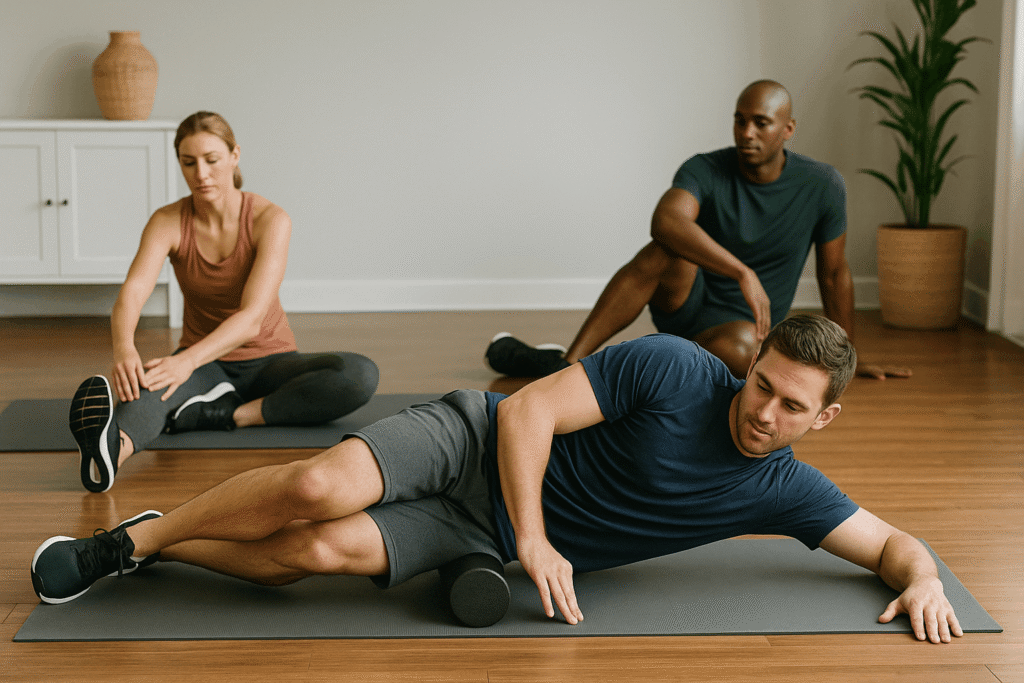
Foam rolling is your first line of defense. Many runners think the IT band itself is the problem, but the actual tension often comes from the muscles that attach to the IT band—your quads, TFL, and glutes. Targeting these is one of the simplest forms of IT Band Relief & Prevention.
Lie on your side with the roller beneath your outer thigh. Slowly roll from your hip down toward your knee, pausing on any tight or tender spots. Spend 30–45 seconds per side and stay relaxed—rolling shouldn’t feel like torture.
Sit on the roller and cross one ankle over the opposite knee, leaning slightly toward the crossed leg side. You’re aiming for the glute muscles that stabilize your pelvis. Roll for 30 seconds per side.
This small but powerful muscle sits right above your hip bone and plays a big role in IT band tension. Lie slightly forward on the roller and find the sensitive spot just below the front of your hip. Roll slowly for 30 seconds per side.
Foam rolling before strength or stretching helps the body move more freely, making it an essential pillar of any IT Band Relief & Prevention routine.
Stretching helps keep your hips, glutes, and quads loose—especially after long periods of sitting, which is one of the biggest contributors to IT band tightness.
Cross your legs and gently lean sideways away from the back leg. You should feel the stretch along the outside of your thigh and hip. Hold for 30 seconds x 2 each side.
Lie on your back, cross one ankle over your opposite knee, and pull the lower leg toward your chest. This releases tension in the glutes, a key factor in IT band mechanics. Hold for 30 seconds x 2 each side.
Kneel on one leg and gently push your hips forward while keeping your core engaged. Tight hip flexors can force your glutes to shut down, placing extra load on the IT band. Hold for 30 seconds x 2 each side.
These stretches are simple but powerful. When done consistently, they create space and mobility around the IT band—major ingredients in long-term IT Band Relief & Prevention.
Weak glutes and hips are one of the biggest underlying causes of IT Band Syndrome. When these stabilizers aren’t pulling their weight, your IT band ends up compensating. The goal here is to strengthen the muscles that help keep your pelvis aligned while you run.
Lie on your side with your knees bent and feet together. Lift your top knee like a book opening, keeping your feet touching. Do 2 sets of 12–15 reps per side.
Lie on your side and lift your top leg straight up. Move slowly and focus on control.
Perform 2 sets of 12 reps per side.
Lie on your back, knees bent, and drive your hips upward while squeezing your glutes at the top.
Do 2 sets of 12–15 reps.
With a resistance band around your thighs or ankles, take 10–15 sideways steps in each direction while staying in a mini-squat.
Complete 2 rounds.
This strength block is one of the most important components of IT Band Relief & Prevention because it develops lasting stability that protects you on every run.
Aim for 2–3 times per week, ideally on:
Non-running days
Easy run days
Or whenever your legs feel especially tight or fatigued
Spread these sessions out—your body benefits more from consistent, moderate work than from one intense session.
Daily routines matter just as much as weekly routines. Whether you’re heading out for a short recovery run or a long mileage day, your IT band needs proper activation before running and thoughtful recovery afterward.
Never stretch cold muscles before a run. Instead, activate your hips, glutes, and stabilizers with dynamic movements. This primes your body for the rhythmic motion of running and reduces the chances of compensations that strain the IT band.
Jog in Place: 1 minute
High Knees: 30 seconds
Butt Kicks: 30 seconds
Side Shuffles: 30 seconds each side
Ankle Inversion and Eversion: 30 seconds
Hip Flexion Mobility: 30 seconds each side
Leg Swings (Front and Side-to-Side): 30 seconds each side
This quick sequence raises your heart rate, activates your core, and turns on the glutes—all essential elements of IT Band Relief & Prevention on run days.
Your post-run ritual changes depending on how demanding the run was.
Keep it simple:
Quick IT Band Stretch — 30 seconds each side
Quick Glute Stretch — 30 seconds each side
This light routine keeps things loose without adding extra stress.
When the workload increases, your recovery should too:
Foam roll: IT band, quads, glutes — 5 minutes total
Deeper stretches (IT Band Stretch, Figure-4, Hip Flexor): 2 x 30 seconds each side
Optional icing on the outer knee if there’s inflammation
These deeper recovery steps help prevent post-run tightness from building up over time. They are a core part of IT Band Relief & Prevention, especially when mileage climbs.
Here’s how your week might look when you plug in both routines:
Monday: Easy Run → Pre-run warm-up + Quick stretch after
Tuesday: Strength + Mobility Routine (Part 1)
Wednesday: Easy Run → Warm-up + Quick post-run stretch
Thursday: Strength + Mobility Routine (Part 1)
Friday: Rest or cross-train
Saturday: Long Run → Warm-up + Full post-run recovery
Sunday: Strength + Mobility (Part 1) or Rest
Follow this for 4–6 weeks and you’ll almost always notice reduced tension, improved stride stability, and more comfortable running. IT Band Relief & Prevention is all about consistency, and this schedule helps you stay on track.
Your IT band isn’t the enemy—it’s a messenger. Pain usually means the surrounding muscles are tight, weak, or overloaded. By combining:
Weekly mobility and strength
Smart pre-run activation
Thoughtful post-run recovery
…you’ll relieve existing tightness while building long-term durability. This is the heart of sustainable IT Band Relief & Prevention: simple routines, repeated consistently, that keep your legs moving freely and keep you enjoying your runs.
Most runners begin to feel improvements within 2–4 weeks if they follow a consistent routine, but full recovery can take 6–8 weeks depending on the severity. The key is reducing inflammation early, then gradually restoring strength and mobility. Rushing back into high-volume running often leads to recurring pain, so pacing your recovery is essential.
Many runners can continue running if the pain is mild and doesn’t worsen during the activity. The focus should be on reducing speed, cutting down mileage, and avoiding hills or speed work temporarily. Paired with a strong IT Band Relief & Prevention routine, easy running can actually help maintain fitness without further aggravation.
Rolling directly over the IT band can feel uncomfortable, and the band itself doesn’t stretch much. The real benefit comes from rolling the surrounding muscles—the TFL, glutes, and quads. These areas contribute most to IT band tension, and improving their mobility has a much bigger impact on overall relief and prevention.
Common causes include weak glutes, tight hips, poor running form, sudden mileage increases, or uneven terrain. Sometimes even worn-out shoes contribute to instability. The combination of strength, mobility, and proper warm-ups is what makes IT Band Relief & Prevention so effective for long-term correction.
You shouldn’t stop strength work altogether, but you may need to modify it temporarily. Avoid deep squats or lateral movements that aggravate the pain. Instead, focus on targeted exercises like bridges, clamshells, and gentle hip strengthening. These movements support recovery while building stability for the long haul.
Downhill running increases the load on your lateral knee structures because your legs are absorbing more impact. The IT band works harder to stabilize your stride, and if it’s already irritated, downhill movement can intensify symptoms. Strengthening your glutes and hips reduces this strain significantly.
Worn-out shoes or shoes with poor lateral support can cause instability with each step. This instability forces the IT band to work harder to keep your legs aligned. Choosing well-supported running shoes and rotating pairs can help prevent the repetitive stress that leads to irritation.
Static stretching isn’t recommended before running because it doesn’t properly activate your muscles and can reduce power output. Dynamic warm-ups are far more effective. Static stretching becomes valuable after your run when your muscles are warm and more receptive to lengthening.
Yes. Long hours of sitting shorten your hip flexors and weaken the glutes, creating imbalances that place more strain on the IT band during running. Incorporating regular breaks, hip mobility work, and glute activation throughout the week can counteract these effects.
If pain persists for more than 3–4 weeks despite consistent routine work—or if the pain becomes sharp, severe, or affects daily movement—it’s time to consult a professional. A therapist can identify specific weaknesses or imbalances and tailor a more targeted plan for IT Band Relief & Prevention.

Every step forward deserves a high-five.✋
Address:
Plot 21 Krishnapuram Beside Income Tax Colony Rd No 10 Banjara Hills, Hyderabad, 500034, India
Write to us at:





