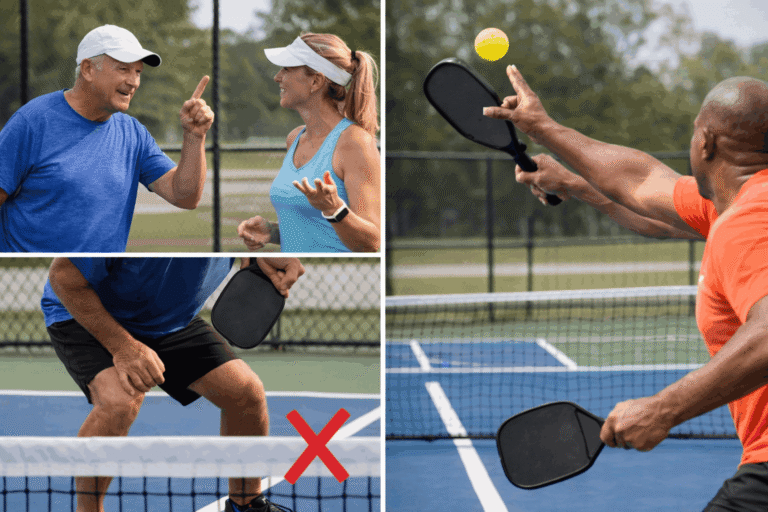
If you’ve ever watched a pickleball game and felt confused about what was happening, you’re not alone. Many new players love hitting the ball but feel unsure about the rules. That’s exactly why this guide exists.
This blog breaks down Pickleball Rules in the simplest way possible. No rulebook language. No overthinking. Just clear explanations that help you feel confident enough to step on the court and play.
By the end, you’ll understand how scoring works, how to serve correctly, why the kitchen rule exists, and which beginner mistakes to avoid.
How Pickleball Scoring Works (Simple Examples)
Scoring is often the most confusing part of Pickleball Rules, but it doesn’t have to be.
The Basics
Games are usually played to 11 points
You must win by 2 points
Only the serving team can score
If you’re not serving, you cannot earn a point—no matter how good your rally was.
Doubles Scoring (The One That Confuses Everyone)
In doubles, the score has three numbers, like this:
7–5–2
Here’s what each number means:
Serving team’s score (7)
Receiving team’s score (5)
Server number (1 or 2)
Each team gets two servers, except at the very start of the game.
Simple example:
If your team wins a rally while serving, you get a point.
If you lose the rally, the serve passes to your partner.
Lose again? The other team serves.
Key Takeaway: Only the serving team scores—this rule alone clears up most confusion.
Singles Scoring (Much Easier)
Singles scoring follows the same idea:
Only the server scores
Score is called as two numbers, not three
Serve from the right side when your score is even
Serve from the left side when your score is odd
This is one area where Pickleball Rules are simpler than doubles.
Pickleball Serving Rules (Explained Clearly)
The 4 Rules That Actually Matter
When serving, you only need to remember these four rules:
Serve underhand
The paddle must move upward in a smooth motion. Overhand or sidearm serves are not allowed.
Contact the ball below your waist
The paddle must strike the ball below your belly button. This keeps serves controlled and beginner-friendly.
Serve diagonally across the court
The ball must land in the opposite service box. Serving straight ahead or into the wrong box results in a fault.
Both feet stay behind the baseline
At least one foot must remain behind the baseline until the ball is hit. Stepping on or over the line before contact is illegal.
What This Means for Beginners
If you follow these four rules, your serve will almost always be legal. Accuracy matters far more than speed, especially when you’re new to the game.
You don’t need spin, power, or advanced techniques. A simple, controlled serve that lands in the correct box is all you need to start the point.
Beginner Tip:
Aim for consistency, not strength. Getting the serve in play is the real goal when you’re learning.
The Double-Bounce Rule (Very Important)
Before learning the kitchen rule or advanced shots, this is the one rule every beginner must understand. The double-bounce rule controls how each point starts and makes the game fair for both teams.
How the Double-Bounce Rule Works
After the serve, the ball must bounce once on each side before anyone can hit it out of the air.
Here’s the simple order:
Serve – The serving team hits the ball
First bounce – The receiving team must let it bounce
Second bounce – The serving team must let the return bounce
After that – Players may volley or let the ball bounce
👉 Serve → Bounce → Return → Bounce → Play normally
Why This Rule Exists
This rule slows the game down at the start of each rally. It prevents players from rushing the net immediately and gives beginners time to move into position and react to the ball.
It also creates longer, more balanced rallies instead of quick points.
Common Beginner Mistake
Volleys too early after the serve.
Many beginners try to hit the ball out of the air before the two required bounces. When this happens, the point is lost—even if the shot goes in.
Beginner Tip:
If you’re unsure, let the ball bounce. It’s always the safer choice when learning.
The Kitchen Rule (Non-Volley Zone Explained)
The kitchen is one of the most talked-about and misunderstood parts of pickleball rules. Once you understand it, the game becomes much easier and more enjoyable.
What Is the Kitchen?
The kitchen is the 7-foot area on both sides of the net.
Its official name is the Non-Volley Zone.
While standing in this area—or even touching the line—you cannot hit the ball out of the air. Any volley taken while your foot is in the kitchen or on its line results in a fault.
However, you are allowed to step into the kitchen after the ball bounces to hit a ground stroke.
Why the Kitchen Rule Exists
Without the kitchen rule, players could stand at the net and smash the ball on every shot. This would make the game fast, aggressive, and difficult for beginners.
The kitchen rule:
Encourages soft, controlled shots called dinks
Creates longer and more enjoyable rallies
Adds strategy instead of constant power
It forces players to think about placement and patience rather than strength.
Common Beginner Mistake
Many beginners accidentally step into the kitchen while volleying or touch the line without realizing it. Even a small toe on the line counts as being in the kitchen.
Beginner Tip:
If you hit the ball out of the air, quickly check your feet. Staying balanced behind the kitchen line helps avoid faults.
Key Takeaway
The kitchen isn’t bad—it’s just misunderstood.
Once you learn how and when to use it, it becomes one of the most fun and strategic parts of pickleball.
Singles vs Doubles Rules (Only What Matters)
Many Pickleball Rules are the same in singles and doubles, but a few differences matter.
What’s the Same
Court size
Serving style
Kitchen rules
Scoring to 11
What’s Different
| Rule Area | Singles | Doubles |
|---|---|---|
| Number of players | 1 per side | 2 per side |
| Score call | 2 numbers | 3 numbers |
| Movement | More running | More teamwork |
| Serve rotation | Simple | Alternates partners |
If you’re new, doubles is usually easier and more social.
Top 5 Rule Mistakes Beginners Make
Let’s clean up the most common pickleball rule mistakes before they happen. Most beginner errors come from rushing and not understanding positioning, not from lack of effort.
1. Volleys in the Kitchen
Stepping into the kitchen—or even touching the line—while volleying is a fault. Your momentum also matters. If you volley and then step into the kitchen, the point is still lost.
Beginner Tip:
Keep your feet balanced behind the kitchen line before volleying.
2. Serving Overhand
Even a slightly overhand serve is illegal. The serve must be underhand, with the paddle contacting the ball below the waist. Trying to add power usually leads to faults.
Beginner Tip:
Smooth and controlled serves are more reliable than hard ones.
3. Forgetting the Double-Bounce Rule
Many beginners volley too soon after the serve. Both teams must let the ball bounce once before volleys are allowed.
Beginner Tip:
When in doubt, let the ball bounce.
4. Incorrect Score Calling
In doubles, the score has three numbers, and beginners often forget the server number. Incorrect score calls can confuse everyone on the court.
Beginner Tip:
Pause and say the score clearly before serving.
5. Standing in the Wrong Service Box
Serving from the wrong side of the court is a common mistake. Your serving position depends on whether your score is even or odd.
Beginner Tip:
Even score = serve from the right, odd score = serve from the left.
Common Mistake Callout
Trying to play fast before understanding the rules.
Slowing down, learning positioning, and following the rules leads to better rallies and more enjoyable games.
Why Learning the Rules Boosts Confidence
Understanding pickleball rules isn’t about being perfect—it’s about feeling comfortable and relaxed on the court. When you know what’s happening and why, the game stops feeling confusing and starts feeling enjoyable.
When you understand the rules, you know:
Where to stand, so you’re not guessing your position
When to hit, so you’re not rushing or hesitating
Why a fault happened, instead of feeling frustrated or embarrassed
This knowledge removes uncertainty. You stop second-guessing every shot and start focusing on playing the game.
Confident players move more calmly, communicate better with partners, and recover quickly from mistakes. Confidence doesn’t come from winning—it comes from understanding.
Key Takeaway:
Knowing the rules lets you relax, trust your decisions, and enjoy pickleball more from the very first game.
Why Pickleball Rules Are Beginner-Friendly
Compared to other sports, pickleball rules are designed for accessibility.
Short games
Simple scoring goals
Limited serve advantages
Clear fault definitions
This is why beginners often improve quickly and feel confident stepping onto the court.
Final Thought
Rules shouldn’t scare you away from a sport. In pickleball, they exist to make the game fair, social, and fun.
Once you understand the basics, the rest comes naturally—one rally at a time.
If you remember just one thing about Pickleball Rules, remember this:
They’re there to help you enjoy the game, not complicate it.