
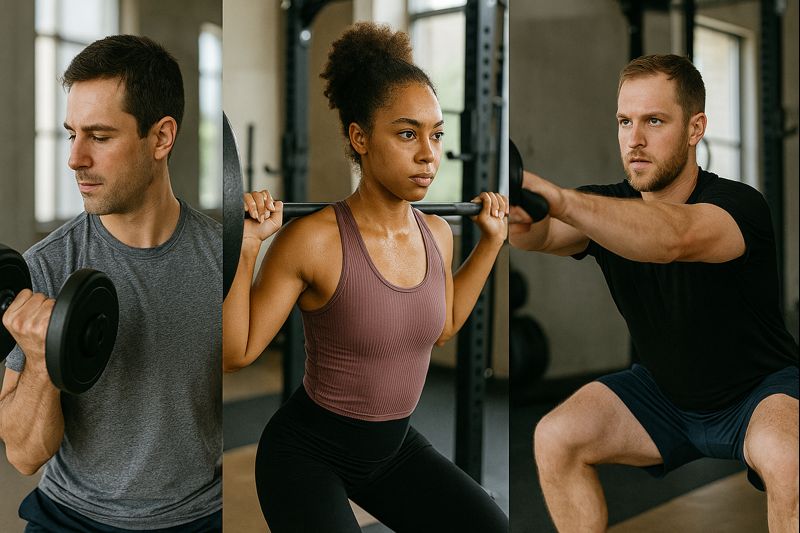
Resistance, Strength & Functional Training: Breaking Down the Basics Simply and Clearly
Walk into any gym (or scroll through your fitness reels), and you’ll hear trainers throw around terms like resistance training, strength training, and functional training. They sound similar. They sometimes overlap. They’re often used interchangeably.
But they’re not the same thing.
And understanding the difference between resistance strength and functional training is one of the smartest things you can do for your fitness progress. Knowing this lets you train with purpose, choose the right exercises for your goals, and avoid wasting time on workouts that don’t serve you.
So let’s break it all down—simply, clearly, and without overcomplicating things.
🎯 Resistance Training: The Big Umbrella
Resistance training is the broadest category. It includes almost everything where your muscles must work against force—whether that force is:
Dumbbells
Resistance bands
Machines
Bodyweight
Gravity
Water resistance
Cable machines
If your muscles have to fight, push, pull, stabilize, or control an external or internal force, you’re doing resistance training. This is why it’s considered the foundation of all physical training, no matter your sport, age, or fitness level.
Examples of Resistance Training
Bodyweight squats
Bicep curls
Resistance band rows
Wall sits
Push-ups
Glute bridges
Resistance training forms the base from which strength and functional training branch off. So when you ask, “What’s the difference between resistance strength and functional training?” remember that all strength work and most functional work fall under this big umbrella.
Why Resistance Training Matters
It improves:
Muscle endurance
Basic strength
Joint stability
Overall movement control
Muscular balance
Body awareness
Common Mistake
Jumping into heavy lifting too soon.
People often skip foundational resistance movements and rush into advanced strength work. But learning control and form under light resistance is what keeps your future training safe.
💪 Strength Training: Lifting Heavy for Raw Power
Strength training is a specific type of resistance training. The main goal is crystal clear:
🎯 Build muscle mass and increase your physical power.
It uses heavier weights, fewer reps, more structured sets, and progressive overload—meaning you gradually increase weight, reps, or intensity over time.
This is the training style that dramatically changes the way your body looks and performs.
Common Strength Training Exercises
Deadlifts
Barbell squats
Bench press
Weighted pull-ups
Overhead presses
Heavy kettlebell work
Who Strength Training Is Perfect For
Anyone who wants to build muscle
People who want measurable progress
Athletes who need power
Individuals who want better posture, bone density, metabolism, or joint strength
Strength training is often where people see the biggest physical transformations. And when we talk about the difference between resistance strength and functional training, strength training sits in the middle—more focused than general resistance training and more power-driven than functional training.
Pro Tip
Use progressive overload intentionally.
You don’t have to add weight every week. You can add reps, slow down tempo, improve form, or increase sets. Progress is progress.
⚙️ Functional Training: Movement That Transfers to Real Life
Functional training focuses on how your body moves outside the gym. Instead of isolating muscles, it trains your entire body to work as a unit—the way it naturally does when you walk, carry groceries, play with your kids, or rotate your torso in a sport.
Examples of Functional Training
Kettlebell swings
TRX rows
Step-ups
Farmer carries
Single-leg deadlifts
Sled pushes
Rotational core exercises
Functional training improves:
Mobility
Balance
Coordination
Stability
Joint strength
Injury prevention
This is where we see another layer of the difference between resistance strength and functional training—functional training is about real-world usefulness, not just weight lifted.
Key Takeaway
Functional training gives you “life strength.” It makes daily tasks easier, reduces injury risks, and supports longevity.
✨ So, Which One Should You Choose?
Short answer?
You don’t have to choose.
Long answer?
It depends on your goals—but a blend is usually ideal.
Here’s how to create a simple roadmap based on understanding the difference between resistance strength and functional training:
If You’re a Beginner:
Start with resistance training using bodyweight or light dumbbells.
Learn foundational patterns:
Squat
Hinge
Push
Pull
Lunge
Rotate
This builds control, stability, and confidence.
As You Build Confidence:
Add strength training 2–3 times a week.
Think:
Moderate to heavy weights
Structured sets
Lower reps
Clear progress metrics
You will feel your muscles getting stronger and see your body changing.
Long-Term Training:
Combine:
Strength training for power and muscle
Functional training for mobility, balance, and longevity
Resistance training as the foundation that ties it all together
When you understand the difference between resistance strength and functional training, it becomes obvious that they complement—not compete with—each other.
📊 Comparison Table: Understanding the Difference Between Resistance Strength and Functional Training
To make everything even simpler, here’s a clear comparison of how each style differs across key attributes.
| Attribute | Resistance Training | Strength Training | Functional Training |
|---|---|---|---|
| Purpose | Build basic muscle endurance and control | Build maximal strength and muscle mass | Improve real-life movement and mobility |
| Weight Used | Light to moderate | Moderate to heavy | Light to moderate, dynamic |
| Primary Focus | General muscle activation | Power, force output, hypertrophy | Movement quality, coordination |
| Reps & Sets | High reps, varied sets | Low reps, structured sets | Varied reps, movement-focused |
| Skill Level | Beginner-friendly | Intermediate to advanced | All levels |
| Movement Type | Isolated or compound | Mostly compound | Multi-planar and dynamic |
| Best For | Beginners building foundation | Muscle growth, strength goals | Everyday function, injury prevention |
| Equipment | Bodyweight, bands, dumbbells | Barbells, heavy weights | Kettlebells, TRX, sandbags |
| Progress Measure | Endurance & ease of movement | Weight, reps, strength metrics | Mobility, balance, movement efficiency |
| Real-Life Transfer | Moderate | Moderate | Very high |
This table reinforces the difference between resistance strength and functional training, showing how each category supports different goals while also overlapping.
🎯 The Smartest Way to Train
Fitness isn’t about choosing sides.
It’s about building a body that can lift well, move well, and live well.
So whether you’re pressing a barbell, swinging a kettlebell, or doing squats on a TRX strap—if you’re challenging your muscles, you’re on the right track.
And the more you understand the difference between resistance strength and functional training, the smarter and more effective your workouts become.
💡 Interested in a beginner-friendly mix of strength + functional workouts?
Drop a 💪 in the comments or DM @stayfitwithvg!
🎥 Watch the original Instagram reel here:
The reel quickly breaks down the differences between resistance, strength, and functional training with simple visuals and examples, helping beginners understand how each training style works and when to use it.







