
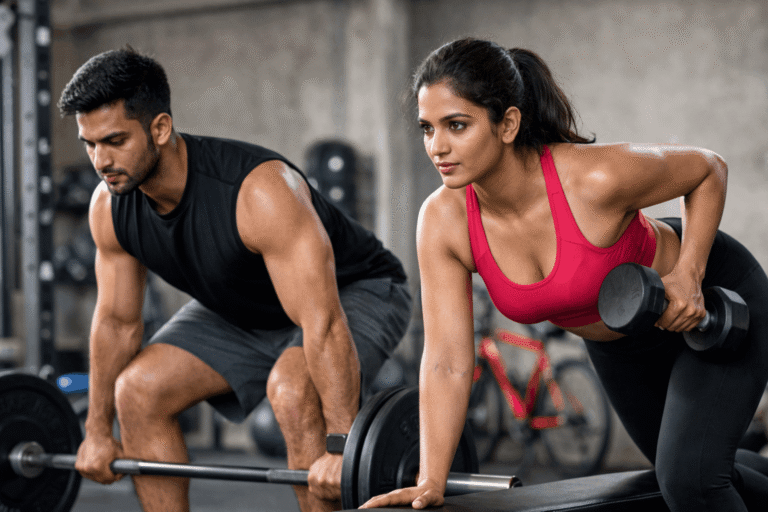
Many cyclists believe that riding more miles is the only way to get better. While time on the bike is essential, it is not enough. If you want stronger sprints, smoother climbs, and fewer injuries, you need to train off the bike too. That is where Strength Training for Cyclists becomes important.
Cycling is repetitive. You pedal thousands of times in the same motion. Over time, this creates muscle imbalances, weak stabilizers, and limited power output. Gym training fills those gaps. It builds stronger muscles, improves joint stability, and increases force production.
In simple terms: stronger muscles push harder on the pedals.
Strength Training for Cyclists is not about bodybuilding. It is about building usable power, improving balance, and protecting your body for long-term performance.
The legs are the engine of cycling. But strong legs are not just about big quads. You need balanced strength in glutes, hamstrings, calves, and stabilizing muscles.
Squats are one of the most effective exercises for cyclists. They train the hips, quads, and glutes together — just like the pedal stroke.
When done correctly, squats improve:
Explosive power
Climbing strength
Joint stability
Neuromuscular coordination
Start with bodyweight squats to master form. Then progress to goblet squats or barbell back squats.
Pro Tip:
Focus on driving through your heels. This activates your glutes more, which are critical for climbing power.
Common Mistake:
Letting knees collapse inward. This reduces power and increases injury risk.
Deadlifts strengthen the posterior chain — glutes, hamstrings, and lower back. These muscles are often underdeveloped in cyclists who only ride.
A strong posterior chain helps:
Generate more torque
Maintain posture on long rides
Reduce lower back fatigue
Romanian deadlifts are especially useful because they emphasize hamstrings, which support the pedal pull phase.
Key Takeaway:
If squats improve your push, deadlifts improve your stability and force transfer.
Step-ups closely mimic the single-leg motion of cycling. They also improve balance and coordination.
Benefits include:
Better unilateral strength
Improved knee control
Reduced muscle imbalances
Use a bench or box at knee height. Step up with control, and avoid pushing off the back leg.
Pro Tip:
Slow down the lowering phase. Eccentric control builds resilience in tendons and ligaments.
Cycling is not just about legs. A weak core wastes energy. If your torso moves excessively while pedaling, power leaks away.
Strength Training for Cyclists must include core stability work to create a solid base.
Planks train endurance in the deep abdominal muscles. These muscles stabilize your spine during long rides.
Hold a plank with a neutral spine. Avoid sagging hips or lifting too high.
Progressions:
Side planks
Plank with leg lift
Weighted planks
Strong core muscles help you:
Maintain aero position longer
Reduce back pain
Improve bike handling
Even though cycling looks linear, your body constantly resists rotation. Wind, terrain, and upper-body movement all create rotational forces.
Exercises like:
Cable rotations
Medicine ball throws
Pallof presses
These improve stability and control.
Common Mistake:
Training only sit-ups. Crunches build surface muscles but ignore deep stabilizers.
Key Takeaway:
A strong core equals better power transfer from hips to pedals.
Many cyclists ignore upper body training. But during long rides, your shoulders, back, and arms support your weight.
Weak upper body muscles lead to:
Neck pain
Shoulder fatigue
Poor posture
Shoulder stability exercises prevent overuse injuries.
Include:
Resistance band external rotations
Face pulls
Scapular push-ups
These strengthen the small stabilizing muscles that keep shoulders healthy.
Rows and pull-downs build upper back strength. A strong back helps maintain posture in aggressive riding positions.
Recommended exercises:
Seated cable rows
Lat pull-downs
Dumbbell rows
Pro Tip:
Focus on squeezing shoulder blades together instead of pulling with arms.
Many riders wonder if gym work is worth the time. Here is a clear comparison:
| Attribute | Strength Training for Cyclists | Cycling Only Training |
|---|---|---|
| Power Output | Significantly improved due to increased muscle force | Limited by current muscle strength |
| Injury Prevention | High – improves joint stability and muscle balance | Moderate – repetitive strain risk |
| Muscle Balance | Balanced development | Often quad-dominant |
| Core Stability | Actively improved | Minimal improvement |
| Sprint Performance | Noticeably enhanced | Plateaus over time |
| Climbing Strength | Increased torque production | Dependent on endurance only |
| Bone Density | Improved | Minimal impact |
| Time Efficiency | 2–3 sessions per week | Requires high mileage |
The table clearly shows that combining both methods creates better long-term performance.
You do not need five gym sessions per week. Two to three sessions are enough.
Day 1
Squats – 3 sets of 6–8 reps
Romanian Deadlifts – 3 sets of 8 reps
Planks – 3 x 45 seconds
Dumbbell Rows – 3 sets of 10
Day 2
Step-ups – 3 sets per leg
Lunges – 3 sets
Side Planks – 3 x 30 seconds
Face Pulls – 3 sets
Add:
Heavier compound lifts
Rotational core work
Single-leg Romanian deadlifts
Keep reps lower (4–6) for power phases during off-season.
Off-season: Focus on building strength
Pre-season: Maintain strength with lighter volume
In-season: 1 short session per week for maintenance
Avoid heavy lifting before intense rides.
Common Mistake:
Doing leg day before long endurance rides. This reduces performance and increases fatigue.
Let us break it down simply.
Stronger muscles produce more force.
More force equals greater torque.
Greater torque equals faster acceleration and better climbing.
Also, Strength Training for Cyclists improves neuromuscular efficiency. This means your brain and muscles communicate better. You recruit more muscle fibers with less effort.
Over time, riders notice:
Faster sprint finishes
More stable descending
Less fatigue in the lower back
Better pedaling mechanics
Cyclists often suffer from:
Knee pain
IT band syndrome
Lower back strain
Neck stiffness
Gym training strengthens connective tissue and corrects imbalances.
For example:
Weak glutes can cause knee tracking problems. Strengthening them reduces stress on joints.
Key Takeaway:
Stronger muscles protect joints.
This is a common question.
During off-season:
Lift heavy (75–85% of 1RM)
Focus on low reps (4–6)
During season:
Moderate weight
Focus on maintenance
You are training for power, not muscle size. Controlled movement matters more than maximum weight.
Strength sessions increase muscle repair needs.
Focus on:
Adequate protein (1.6–2.2 g/kg bodyweight)
Carbohydrates for energy
Hydration
Without proper nutrition, gym sessions may increase fatigue without performance benefits.
Training in the gym builds discipline and confidence. When you lift heavier weights over time, you feel stronger on the bike.
This psychological boost often translates into better race performance.
Strength Training for Cyclists is not just physical — it builds mental resilience too.
Cycling will always be the foundation of performance. But ignoring gym training limits your potential.
Strength Training for Cyclists improves power, protects against injury, enhances balance, and increases overall efficiency. It complements your time on the bike rather than replacing it.
If you want smoother rides, stronger sprints, and better climbing, start with two gym sessions per week. Keep it simple. Focus on compound movements. Stay consistent.
Stronger muscles lead to smoother rides.
Most cyclists benefit from two to three sessions per week during the off-season. During competition season, one maintenance session is enough. Consistency matters more than volume. Overtraining can reduce cycling performance, so balance is key. Listen to your recovery signals and adjust accordingly.
No. Cyclists typically train with lower reps and controlled volume focused on strength, not hypertrophy. Building large muscle mass requires high-calorie intake and bodybuilding-style programming. Proper strength work increases power without unnecessary weight gain, improving power-to-weight ratio.
If strength is your priority, lift first. If cycling performance that day matters more, ride first. Avoid heavy lifting before long endurance rides or interval sessions. Ideally, separate gym and cycling sessions by several hours or different days.
Yes. Beginners should start with bodyweight exercises and focus on learning proper technique. Gradual progression reduces injury risk. Working with a coach initially can help ensure safe movement patterns and better results.
Absolutely. Core stability supports efficient force transfer and reduces fatigue. A weak core wastes energy and can lead to lower back pain. Planks and anti-rotation exercises are especially effective for endurance athletes.
The off-season is ideal for building maximum strength. During this period, cycling intensity is lower, allowing better recovery. As race season approaches, shift to maintenance and power-focused exercises.
Most cyclists notice improvements in stability and power within 4–6 weeks. Measurable increases in strength occur even sooner. However, consistent training over months produces the most noticeable performance gains.
Yes. Strength training is especially important for aging athletes. It preserves muscle mass, improves bone density, and reduces injury risk. It also helps maintain metabolic health and overall mobility.
Yes. Whether you ride outdoors or indoors, the repetitive motion remains the same. Indoor cycling does not eliminate muscle imbalances. Off-bike training still improves power, posture, and injury resistance.
You can begin with minimal equipment: dumbbells, resistance bands, and a stable bench. As you progress, access to barbells and cable machines adds variety and load options. Proper form matters more than expensive equipment.


Every step forward deserves a high-five.✋
Address:
Plot 21 Krishnapuram Beside Income Tax Colony Rd No 10 Banjara Hills, Hyderabad, 500034, India
Write to us at:





