
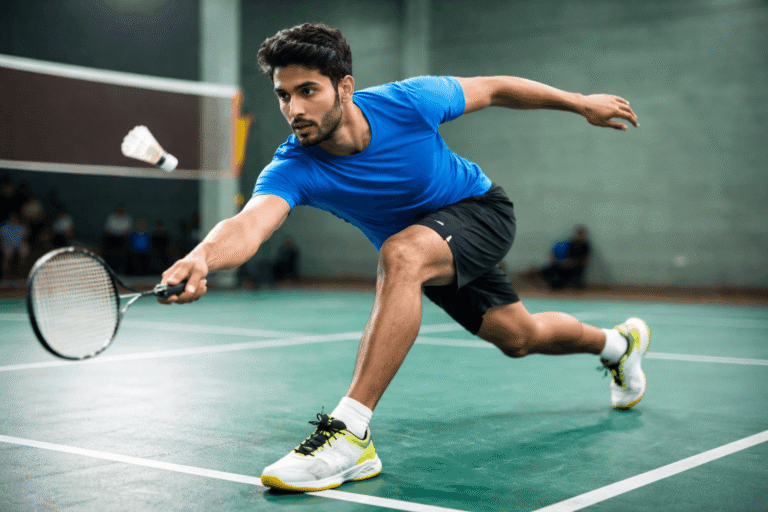
Many players believe smashing harder wins matches. But in reality, movement wins more points than power ever will. You can have the strongest smash in your club, but if you cannot reach the shuttle on time, that power becomes useless.
This is where Badminton Footwork becomes the foundation of your game.
Footwork is not just about running fast. It is about moving efficiently, staying balanced, and recovering quickly. Good movement allows you to reach difficult shots with control. It gives you time. And in badminton, time is everything.
When you improve your Badminton Footwork, you:
Reach shots earlier
Maintain balance while hitting
Reduce unforced errors
Save energy during long rallies
Control the pace of the match
Movement wins points because it keeps you in control. Even defensive players who rarely smash hard can dominate matches simply because they move better than their opponents.
Every rally is a battle for positioning. The player who reaches the shuttle early usually controls the shot.
When you move well:
You hit from a balanced position.
You can choose different shot options.
You recover faster to your base position.
You put pressure on your opponent.
Bad footwork forces rushed shots. Rushed shots create mistakes. That is why mastering Badminton Footwork is one of the smartest ways to improve quickly.
Before advanced tactics, you must master the basics. These patterns are the foundation of all court movement.
Side steps are small, quick movements used for short lateral .adjustments.
They are essential when:
Defending smashes
Covering fast drives
Adjusting position near the net
The key is to stay low, keep your knees bent, and avoid crossing your feet unnecessarily. Your weight should remain on the balls of your feet.
Stay light and relaxed. Tension slows you down. The quicker your first step, the better your defense.
Chasse steps are commonly used to move sideways across the court quickly.
In this movement:
One foot leads.
The other foot follows and “chases.”
Your body stays facing forward.
This technique helps maintain balance while covering wider areas of the court.
Good chasse movement improves rhythm and keeps your body stable while preparing for overhead shots.
The lunge is critical for net shots and front-court retrievals.
A proper lunge includes:
Long step forward
Front knee bent at 90 degrees
Back leg extended
Upper body upright
After contact, you must push explosively back to base position.
Poor lunge recovery wastes energy and leaves you exposed.
Leaning too far forward and losing balance. This makes recovery slow and increases injury risk.
Moving backward efficiently is one of the most challenging parts of Badminton Footwork.
Many beginners run backward directly. This is incorrect.
Instead:
Turn your hips
Use a pivot step
Move diagonally
Stay balanced for overhead shots
Proper backward movement ensures powerful clears and smashes because you are positioned correctly.
Even experienced players struggle with movement errors. Let’s correct the most common ones.
If your heels are on the ground, you are already late.
Always stay on the balls of your feet. This position allows faster reactions.
Your ready position decides your speed. Stay light, knees bent, and alert.
Crossing legs at the wrong time destroys balance.
While crossover steps are sometimes necessary for long distances, careless crossing can:
Slow recovery
Cause slips
Lead to awkward body positioning
Footwork should be controlled and purposeful, not rushed.
One of the biggest errors in badminton is admiring your shot.
After every shot, return quickly to your base position — the central ready area of the court.
Good Badminton Footwork is not just about reaching the shuttle. It is about recovering instantly.
Think “hit and recover” every time. Make recovery automatic.
You cannot improve movement by just playing games. You need focused training.
Here are powerful drills to sharpen your speed and agility.
This is one of the best drills for improving Badminton Footwork.
How it works:
No shuttle needed.
Move to all six corners of the court.
Practice correct steps and recovery.
Maintain match intensity.
Shadow practice builds muscle memory and improves coordination.
Quality matters more than speed. Practice correct movement first, then increase pace.
Agility ladders improve quick feet and coordination.
Common ladder patterns:
In-and-out steps
Side shuffle
Single-leg hops
Crossover patterns
These drills improve explosive movement and reaction speed.
But remember, ladder work supports badminton movement — it does not replace court practice.
This is a high-intensity drill.
A coach feeds multiple shuttles quickly to different corners. The player must react and move rapidly.
Benefits:
Improves stamina
Sharpens reaction time
Builds recovery speed
Simulates match pressure
Focusing only on speed while ignoring technique. Always maintain proper movement form.
Speed alone is not enough. Smart movement is even more powerful.
Watch:
Shoulder rotation
Racket angle
Body positioning
Speed of swing
These clues tell you where the shuttle is likely to go.
When you anticipate correctly, you move earlier. Early movement feels like extra speed.
Study your opponent’s patterns.
Notice repeated shot choices.
Stay mentally alert between rallies.
Position slightly toward their stronger side.
Advanced players win rallies because they move before the shuttle is hit.
That is the true power of refined Badminton Footwork.
Footwork is supported by strength and endurance.
Focus on:
Leg strength (squats, lunges)
Core stability
Calf conditioning
Interval training
Plyometrics
Stronger legs improve push-off power. Better stamina helps maintain movement quality in long matches.
Train explosiveness, not just endurance. Quick bursts matter more than slow jogging.
Many players train physically but ignore mental sharpness.
Concentration directly affects footwork.
When focus drops:
Reaction slows
Recovery becomes lazy
Positioning becomes poor
Stay mentally engaged throughout the match.
Incorrect movement increases injury risk.
Common issues:
Knee strain
Ankle sprains
Achilles problems
Lower back stress
Correct Badminton Footwork reduces impact and protects joints.
Warm up properly before playing:
Dynamic stretches
Light court movement
Practice lunges
Never skip recovery training.
Badminton is not about hitting harder. It is about moving smarter.
Mastering Badminton Footwork changes everything:
You reach more shuttles.
You control rallies.
You feel less tired.
You gain confidence.
Movement creates opportunity. Opportunity creates points.
Practice daily. Focus on technique. Build strength. Train your anticipation.
Over time, you will notice something powerful — you are no longer chasing the shuttle.
You are controlling the game.
Improvement depends on consistency. With focused drills three to four times a week, most players see noticeable changes in four to six weeks. However, mastering movement takes months of disciplined practice. The key is repetition with proper technique, not just playing matches casually.
Yes. Strong smashes help finish points, but footwork helps you reach the shuttle consistently. Without good movement, you cannot position yourself correctly for powerful shots. Many professional players win through superior movement rather than pure power.
Yes, shadow practice is safe and effective for beginners. It improves coordination and builds correct movement habits. Start slowly, focus on form, and gradually increase intensity. Even 10–15 minutes daily can produce great improvements over time.
The quadriceps, hamstrings, calves, glutes, and core muscles are crucial. Strong calves improve push-off speed. A stable core improves balance during lunges and recovery. Lower-body strength directly supports better court movement.
Poor conditioning and inefficient movement cause early fatigue. Improve stamina through interval training and focus on proper recovery to base position. Efficient movement conserves energy, allowing you to last longer in matches.
Yes. Badminton shoes provide grip, cushioning, and lateral support. Proper footwear reduces injury risk and improves stability during quick direction changes. Avoid running shoes, as they are not designed for side-to-side movement.
Practice multi-shuttle drills and train your anticipation by studying opponents. Reaction speed improves when your brain processes visual cues faster. Staying on the balls of your feet also improves your first step quickness.
Balance issues often come from weak core muscles or improper lunge technique. Keep your upper body upright and avoid leaning too far forward. Strength training and slow, controlled practice can fix this issue.
Recovery is critical. Many players focus only on reaching the shuttle but forget to reset. Quick recovery prepares you for the next shot and prevents being caught out of position during fast exchanges.

Every step forward deserves a high-five.✋
Address:
Plot 21 Krishnapuram Beside Income Tax Colony Rd No 10 Banjara Hills, Hyderabad, 500034, India
Write to us at:





