
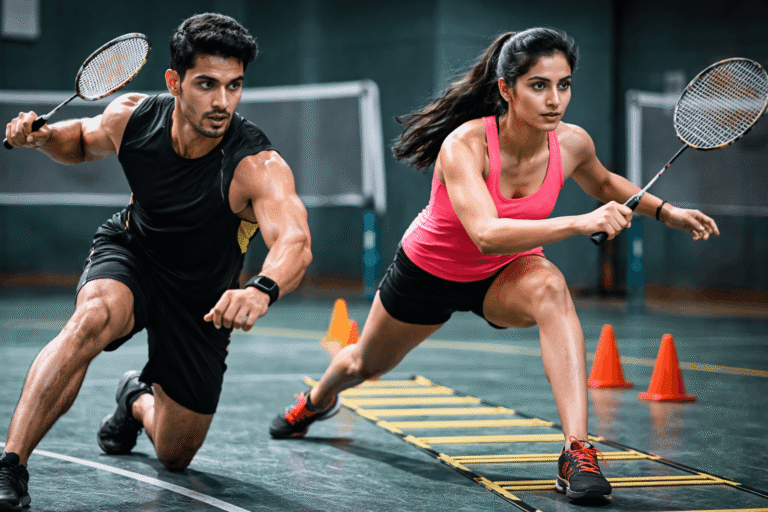
Introduction: Why Badminton Requires Full-Body Conditioning
Badminton looks simple from the outside. Two players. One shuttle. Quick rallies.
But anyone who has played seriously knows the truth — badminton is one of the most physically demanding sports in the world.
It requires:
Explosive speed
Strong legs
Stable core
Powerful shoulders
Quick reactions
Long-lasting stamina
This is why Badminton Fitness Training is essential if you want to improve your game.
Badminton is not just about technique. It is about how long you can maintain speed and control during intense rallies. A match can include hundreds of quick movements — lunges, jumps, smashes, defensive dives, and rapid changes of direction.
Without proper conditioning, even the most skilled player will slow down.
Good fitness allows you to:
Move faster in the third set
Maintain power under fatigue
Recover quickly between rallies
Reduce injury risk
If you want to compete seriously or simply dominate at club level, structured Badminton Fitness Training must be part of your routine.
Cardiovascular Endurance
Badminton is a high-intensity interval sport. Rallies are short and explosive, followed by brief recovery periods.
This means you need both aerobic and anaerobic endurance.
Let’s break it down.
Interval Running
Interval running mimics match conditions.
Instead of steady jogging, you alternate between:
20–30 seconds sprint
30–60 seconds light jog or walk
Repeat for 15–20 minutes.
This trains your heart and lungs to recover quickly between explosive movements.
Why It Works
During a rally, your heart rate spikes. Between rallies, it drops slightly. Interval training prepares your body for these constant changes.
Pro Tip:
Start with shorter sprint intervals if you are a beginner. Focus on good running form before increasing intensity.
Skipping Rope
Skipping rope is one of the most underrated tools in Badminton Fitness Training.
It improves:
Foot speed
Coordination
Calf strength
Cardiovascular endurance
Try 3–5 rounds of:
1 minute fast skipping
30 seconds rest
As you improve, increase duration.
Skipping also strengthens your lower legs, which are heavily used in quick directional changes.
On-Court Endurance Drills
Court-specific conditioning is extremely important.
Example drill:
Move to all six corners of the court.
Touch each corner with your racket.
Return to base each time.
Continue for 60 seconds.
Rest 30 seconds. Repeat 5–8 rounds.
This drill combines movement, endurance, and recovery — all essential elements of strong Badminton Fitness Training.
Common Mistake:
Moving fast but ignoring technique. Poor movement under fatigue creates bad habits.
Strength Training for Badminton
Strength gives power to your speed. Without strength, your movement becomes weak and unstable.
Let’s look at key muscle groups.
Leg Strength (Squats, Lunges)
Your legs generate power for:
Lunges
Jumps
Smashes
Defensive pushes
Squats
Build overall lower-body strength.
Perform 3–4 sets of 8–12 reps.
Lunges
Improve balance and single-leg power.
Forward lunges and side lunges are both important.
Strong legs improve push-off speed and reduce injury risk.
Key Takeaway:
Train single-leg strength. Badminton rarely uses both legs equally.
Core Stability
Your core connects upper and lower body.
A strong core:
Improves balance
Increases smash power
Reduces back injuries
Exercises:
Planks
Side planks
Russian twists
Dead bugs
Hold planks for 30–60 seconds. Focus on form.
Core stability is often ignored in Badminton Fitness Training, but it directly affects control and power.
Shoulder Strength
Smashing repeatedly puts stress on your shoulders.
Strengthen:
Rotator cuff
Deltoids
Upper back
Exercises:
Resistance band external rotations
Dumbbell shoulder press
Face pulls
Light weight with control is better than heavy weight with poor form.
Pro Tip:
Never skip shoulder warm-ups. Strong shoulders protect against long-term injury.
Agility & Reaction Training
Badminton demands lightning-fast reactions.
Speed alone is not enough. You must change direction instantly.
Cone Drills
Set up 4–6 cones in random patterns.
Sprint to each cone as called out by a partner or timer.
This improves:
Acceleration
Direction change
Coordination
Cone drills simulate unpredictable movement in rallies.
Reaction Ball Exercises
A reaction ball bounces unpredictably.
Drop it and catch it after the bounce.
This trains:
Hand-eye coordination
Reaction speed
Focus
You can also combine reaction drills with movement for advanced training.
Shuttle Reaction Drill
Have a partner randomly throw shuttles to different corners.
You react instantly and return to base.
This improves anticipation and mental sharpness — two key elements of advanced Badminton Fitness Training.
Weekly Workout Plan Sample
Here is a simple balanced weekly structure:
| Day | Focus | Key Exercises |
|---|---|---|
| Monday | Cardio + Movement | Interval running + shadow badminton |
| Tuesday | Strength | Squats, lunges, core work |
| Wednesday | Agility | Cone drills + skipping |
| Thursday | Rest / Light recovery | Stretching + mobility |
| Friday | Power + Strength | Jump squats + shoulder training |
| Saturday | On-court endurance | Multi-shuttle drills |
| Sunday | Match Play | Apply fitness in real game |
Important:
Adjust intensity based on your level. Recovery is just as important as training.
Comparison: Cardio vs Strength vs Agility Training
| Attribute | Cardiovascular Training | Strength Training | Agility & Reaction Training |
|---|---|---|---|
| Main Goal | Improve stamina | Build muscle power | Improve speed & coordination |
| Match Impact | Sustain long rallies | Stronger smashes & pushes | Faster response to shots |
| Energy System | Aerobic & anaerobic | Muscle strength system | Nervous system activation |
| Injury Prevention | Improves endurance resilience | Strengthens joints | Enhances movement control |
| Frequency | 2–3 times/week | 2–3 times/week | 2 times/week |
| Equipment Needed | Minimal | Weights or bands | Cones, reaction ball |
| Recovery Time | Moderate | Higher | Low to moderate |
| Best For | Long matches | Power players | Defensive & counter players |
Balanced Badminton Fitness Training includes all three components.
Nutrition and Recovery
Training hard is not enough. Recovery fuels performance.
Focus on:
Protein for muscle repair
Carbohydrates for energy
Hydration
7–8 hours of sleep
Stretch after every session.
Foam rolling improves muscle recovery and reduces soreness.
Mental Conditioning and Fitness
Fatigue affects focus.
When tired:
Footwork slows
Reaction drops
Errors increase
Training under mild fatigue prepares you for real match pressure.
Mental strength is part of effective Badminton Fitness Training.
Injury Prevention Through Conditioning
Common badminton injuries:
Knee pain
Ankle sprains
Shoulder strain
Lower back pain
Strength training protects joints. Proper warm-up improves flexibility.
Always:
Warm up 10 minutes
Activate muscles
Cool down properly
Prevention is easier than recovery.
How Fitness Directly Improves Match Performance
When you improve your fitness, the difference is clear:
You reach shuttles earlier
You maintain power in long rallies
You recover faster between points
You stay mentally sharp
Fitness gives confidence. Confidence improves decision-making.
Over time, structured Badminton Fitness Training transforms your game.
You no longer feel exhausted in the third set.
You feel stronger.
Faster.
More controlled.
That is the true goal — sustainable performance.
Conclusion
Badminton is a fast, explosive, full-body sport.
Technique wins rallies.
Fitness wins matches.
Commit to structured Badminton Fitness Training. Train your endurance. Build your strength. Sharpen your agility.
Stay consistent.
Because when your body is prepared, your skills shine.







