
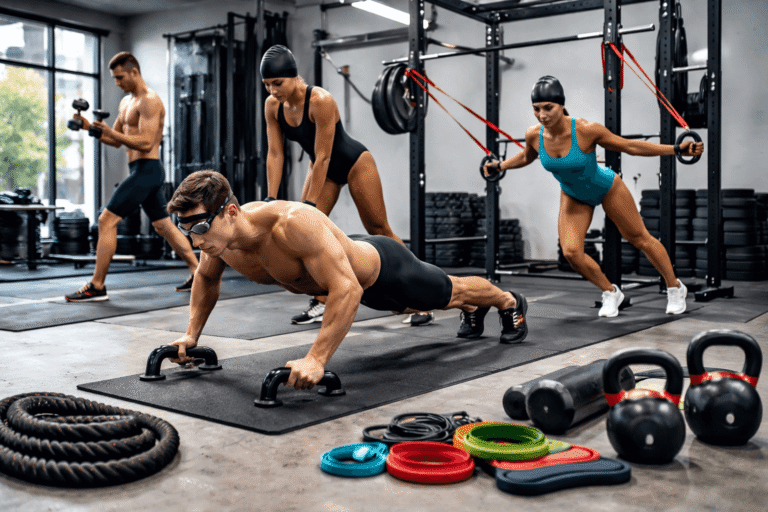
Swimming performance doesn’t start in the water.
It starts in the gym, on the mat, and in the small movements most athletes ignore.
Many swimmers believe that logging more laps automatically makes them faster. While time in the pool is essential, it’s only part of the equation. Strength, mobility, and stability developed outside the water directly influence speed, efficiency, and durability inside it.
That’s where Dryland Training for Swimmers becomes essential.
When structured properly, dryland work improves stroke mechanics, increases power off the blocks, strengthens the core for better body position, and reduces injury risk. Whether you are a competitive swimmer, triathlete, or age-group athlete, integrating Dryland Training for Swimmers can dramatically elevate your performance.
Let’s break it down step by step.
Shoulder pain is extremely common in swimmers. Repetitive overhead motion, especially in freestyle and butterfly, places stress on the rotator cuff and scapular stabilizers.
Without strength balance, overuse injuries develop.
Dryland Training for Swimmers addresses:
Rotator cuff weakness
Scapular instability
Core imbalances
Hip weakness
Postural breakdown
By strengthening supporting muscles, swimmers create joint stability. Stronger muscles absorb stress better, reducing strain on tendons and ligaments.
Swimming is not just endurance. It’s explosive.
Starts, turns, and breakouts demand power from:
Glutes
Core
Lats
Shoulders
Dryland Training for Swimmers builds this explosive strength through resistance training and controlled movements. Stronger muscles produce more force with each stroke, leading to:
Faster sprint times
Stronger push-offs
Better stroke efficiency
Power on land transfers directly to propulsion in water.
Swimming encourages internal shoulder rotation and forward head posture.
If unchecked, swimmers develop:
Rounded shoulders
Tight chest muscles
Weak upper back
Poor thoracic mobility
Dryland work restores balance. Strengthening posterior chain muscles and improving mobility helps maintain streamlined body position.
If you only swim, you train the movement — not the engine behind the movement.
Dryland Training for Swimmers builds that engine.
Let’s focus on foundational movements that directly support swimming performance.
Pull-ups mimic the pulling phase of freestyle and butterfly.
They strengthen:
Lats
Rear delts
Biceps
Core stabilizers
Pro Tip:
Engage your core and avoid swinging. Pull your elbows toward your ribs instead of your chin toward the bar.
Common Mistake:
Overusing momentum. Controlled reps build usable strength.
For swimmers who cannot perform strict pull-ups yet, lat pulldowns build similar strength.
Focus on:
Full stretch at the top
Controlled contraction
Neutral spine
This reinforces proper pulling mechanics without shoulder strain.
Swimming is rotational, especially freestyle and backstroke.
Exercises like:
Cable rotations
Medicine ball throws
Russian twists
Train oblique engagement and torso control.
Pro Tip:
Rotate through the thoracic spine, not the lower back.
Common Mistake:
Rushing reps. Speed without control reduces effectiveness.
Many swimmers have underactive glutes.
Weak glutes cause:
Dropped hips
Poor body alignment
Reduced kick efficiency
Glute bridges activate posterior chain muscles critical for starts and turns.
Pro Tip:
Squeeze at the top for two seconds to maximize activation.
To fully support Dryland Training for Swimmers, also consider:
Deadlifts (posterior chain power)
Planks (core stability)
Face pulls (shoulder health)
Bulgarian split squats (leg drive balance)
Strength without mobility creates restriction.
Mobility without strength creates instability.
Swimmers need both.
Light resistance band exercises:
External rotations
Internal rotations
Scapular retractions
These improve shoulder resilience.
Perform high reps with controlled tempo.
Common Mistake:
Going too heavy. Rotator cuff work should feel controlled, not maximal.
A stiff upper back limits rotation and increases shoulder stress.
Helpful drills:
Cat-cow stretches
Thoracic extensions over foam roller
Open book rotations
Improved thoracic mobility allows better stroke mechanics and breathing patterns.
Healthy shoulders equal consistent training.
Dryland Training for Swimmers isn’t just about strength — it’s about longevity.
Here’s a simple structure for integrating gym work:
Pull-ups (4×6–8)
Lat pulldowns (3×10)
Face pulls (3×12)
Plank variations (3×45 sec)
Glute bridges (4×10)
Bulgarian split squats (3×8 each leg)
Medicine ball rotations (3×12)
Dead bugs (3×10)
Band external rotations (3×15)
Foam roll thoracic spine (5 min)
Scapular push-ups (3×12)
Light core circuit
Keep sessions 30–45 minutes.
Consistency matters more than complexity.
Even motivated athletes often misuse gym time.
High-volume chest workouts create imbalance.
Swimmers need functional strength, not excessive hypertrophy.
Skipping mobility leads to stiffness and shoulder pain.
Form always comes first.
Pro Tip:
If technique breaks down, reduce weight immediately.
Crunches alone won’t build a swimming core. Stability matters more than flexion.
Dryland Training for Swimmers must evolve. Gradually increase load, reps, or complexity.
| Attribute | Pool-Only Training | Pool + Dryland Training |
|---|---|---|
| Strength Development | Limited to bodyweight resistance | Progressive overload builds muscle strength |
| Injury Prevention | Higher overuse risk | Strength balance reduces injuries |
| Power Output | Moderate | Higher explosive performance |
| Postural Correction | Minimal | Actively corrected through exercises |
| Core Stability | Passive engagement | Direct core strengthening |
| Shoulder Health | Repetitive strain | Strength + mobility protection |
| Speed Potential | Plateau likely | Higher performance ceiling |
| Longevity in Sport | Increased burnout risk | Improved durability |
Swimming builds skill.
Dryland Training for Swimmers builds the athlete.
Together, they create peak performance.
If you want faster times, stronger turns, and fewer injuries, the solution is simple:
Train beyond the pool.
Dryland Training for Swimmers enhances power, protects joints, improves posture, and increases performance longevity. It doesn’t replace swimming — it supports it.
The most successful swimmers understand that championships are built outside the water as much as inside it.
Most swimmers benefit from 2–3 dryland sessions per week. This frequency allows strength development without interfering with swim recovery. Younger athletes may start with two sessions, while competitive swimmers can increase to three structured sessions depending on training phase and season.
Yes, when properly supervised. Focus should be on technique, bodyweight movements, and mobility rather than heavy lifting. Teaching movement quality early builds a strong athletic foundation and reduces injury risk as training volume increases.
No. Dryland complements swim training but does not replace water-specific skill development. Swimming technique must be practiced in the pool. Strength training enhances performance but cannot substitute stroke mechanics practice.
Basic equipment like resistance bands, dumbbells, medicine balls, and a pull-up bar are sufficient. Many effective exercises use bodyweight alone. Expensive machines are not necessary to see improvements.
Not if programmed correctly. Swimmers should focus on functional strength and power rather than high-volume hypertrophy training. Proper programming improves muscle efficiency without excessive mass gain.
Athletes as young as 10–12 can begin basic bodyweight and coordination drills. As they mature, resistance can gradually increase. Early exposure helps build balanced strength and movement awareness.
Yes. Explosive exercises improve start speed, wall push-offs, and stroke force. Strength increases force production, which directly impacts sprint performance in short-distance events.
Most swimmers notice improved stability and strength within 4–6 weeks. Measurable improvements in race performance may take 8–12 weeks depending on training consistency and program design.
It depends on age, experience, and season. In the off-season, heavier strength phases can be beneficial. During competition season, moderate loads and maintenance work are more appropriate to avoid fatigue.


Every step forward deserves a high-five.✋
Address:
Plot 21 Krishnapuram Beside Income Tax Colony Rd No 10 Banjara Hills, Hyderabad, 500034, India
Write to us at:





