
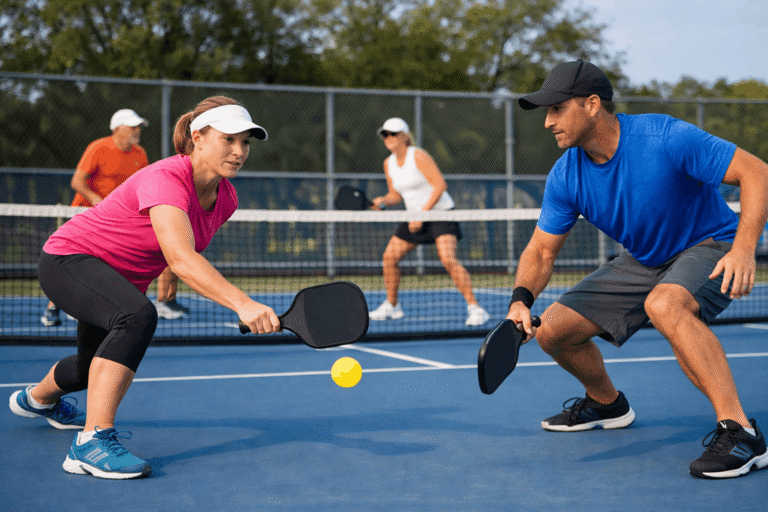
If you watch new pickleball players for five minutes, you’ll notice something quickly—they’re often out of position.
They stand too tall.
They move too late.
They cross their feet awkwardly.
They reach instead of stepping.
The biggest technical gap between beginners and advanced players isn’t power or spin. It’s Pickleball Footwork & Movement.
Many players focus only on paddle skills. But without efficient movement, even the best shot mechanics fall apart. You’ll feel rushed. You’ll lose balance. And most importantly, you increase your risk of knee and ankle injuries.
The good news? Proper Pickleball Footwork & Movement is simple to learn. It’s not about running faster. It’s about moving smarter.
Let’s break it down step by step.
Everything in pickleball starts with your ready position.
A strong ready position includes:
Knees slightly bent
Weight on the balls of your feet
Paddle up in front of your chest
Feet shoulder-width apart
Body leaning slightly forward
This athletic stance prepares you to move in any direction.
Beginners often stand flat-footed and upright. That delay of even half a second affects your reaction time dramatically.
The split step is a small hop timed as your opponent hits the ball.
Why is it important?
It loads your legs like springs. When you land, your muscles are ready to push off instantly in any direction.
In effective Pickleball Footwork & Movement, the split step is your reset button after every shot.
You don’t react after the ball crosses the net. You react as your opponent makes contact.
One of the most misunderstood parts of Pickleball Footwork & Movement is how to move from the baseline to the kitchen (non-volley zone).
In pickleball, the team controlling the kitchen line usually controls the point. Staying back gives your opponents angles and control.
After serving or returning:
Hit your shot
Move forward immediately
Stay low and balanced
Stop just behind the kitchen line
Do not run upright. Use short, controlled steps.
Many players run forward and stop abruptly with straight legs. This makes them unstable and vulnerable to fast shots.
Instead, think “glide forward under control.”
Move forward behind a good shot. If your return is weak, pause and defend before advancing.
Pickleball is less about sprinting forward and backward and more about lateral movement.
When moving side to side:
Use a shuffle step
Keep feet wide
Avoid crossing legs unless chasing a wide ball
Crossing your feet in tight exchanges leads to loss of balance.
In doubles, you and your partner should move like a unit. If they shift right, you shift right. If they shift left, you shift left.
This synchronized movement is a core part of advanced Pickleball Footwork & Movement.
After hitting:
Reset your feet
Re-center your body
Prepare for the next ball
Never admire your shot. Movement is continuous.
Balance separates intermediate from advanced players.
If your weight sits on your heels:
You react slower
You lose forward momentum
You increase fall risk
Lean slightly forward at all times.
For controlled shots:
Transfer weight from back foot to front foot
Keep head steady
Avoid leaning excessively
Power in pickleball doesn’t come from big swings—it comes from proper body positioning and weight shift.
Stable base = consistent shots + fewer injuries.
Injury prevention is one of the most important reasons to improve your Pickleball Footwork & Movement.
Knee tendonitis
Meniscus strain
Ankle sprains
Achilles tightness
Most injuries happen due to:
Poor balance
Sudden stops
Overreaching
Wearing improper footwear
Warm up for 5–10 minutes
Perform light lateral drills
Strengthen glutes and calves
Wear court-specific shoes
Avoid overextending for unreachable balls
If you feel off-balance, reset instead of lunging. One lost point is better than six weeks off the court.
| Attribute | Efficient Movement | Inefficient Movement |
|---|---|---|
| Ready Position | Knees bent, athletic stance | Standing upright |
| Reaction Timing | Uses split step | Flat-footed reaction |
| Lateral Movement | Controlled shuffle | Crossing feet unnecessarily |
| Transition Forward | Smooth, balanced steps | Running upright and stopping abruptly |
| Weight Transfer | Balanced, forward lean | Leaning backward |
| Recovery | Immediate reset after shot | Watching the ball |
| Partner Coordination | Moves together | Moves independently |
| Injury Risk | Lower | Higher |
| Energy Use | Controlled and efficient | Wasted movement |
| Stability | Strong base | Frequent off-balance shots |
This comparison shows how small adjustments dramatically improve performance and safety.
Always expect the ball to come back. Stay ready.
Keep movements short and controlled.
Focus on balance first, speed second.
Record your games to analyze positioning errors.
Practice footwork drills without a paddle.
Improving Pickleball Footwork & Movement doesn’t require hours of conditioning—it requires awareness and repetition.
Standing too tall
Not using a split step
Backpedaling instead of shuffling
Lunging instead of stepping
Watching shots instead of recovering
Wearing running shoes instead of court shoes
Advancing to the kitchen too slowly
Leaning backward during volleys
Correcting these mistakes immediately improves consistency.
Movement matters more than power.
Stay low and balanced at all times.
Shuffle laterally instead of crossing feet.
Transition to the kitchen under control.
Strong footwork reduces injury risk.
The foundation of winning points—and staying healthy—lies in mastering Pickleball Footwork & Movement.
Footwork controls positioning, balance, and recovery. Even perfect paddle technique fails without proper movement. Efficient positioning allows you to hit controlled shots and reduces unnecessary strain on knees and ankles.
The split step is a small hop timed with your opponent’s contact. It prepares your body to move instantly in any direction. It’s a core part of advanced movement patterns.
Shuffling is preferred for most lateral movements. Running upright reduces balance and increases injury risk. Controlled shuffle steps maintain stability.
Move forward after hitting a strong shot. Stay low and take small steps. Avoid sprinting and stopping abruptly.
Court-specific shoes provide lateral support. Running shoes lack side stability and increase ankle injury risk.
Focus on squats, lunges, calf raises, and lateral band walks. Strong glutes and calves improve balance and shock absorption.
You may be standing too upright or not resetting after shots. Staying low improves stability.
It can be if you lunge or stop abruptly. Proper mechanics and warm-ups reduce stress significantly.
Two to three times per week is sufficient. Even 10-minute focused sessions can dramatically improve efficiency.
Yes. Proper weight transfer and positioning generate more controlled power without bigger swings.


Every step forward deserves a high-five.✋
Address:
Plot 21 Krishnapuram Beside Income Tax Colony Rd No 10 Banjara Hills, Hyderabad, 500034, India
Write to us at:





