
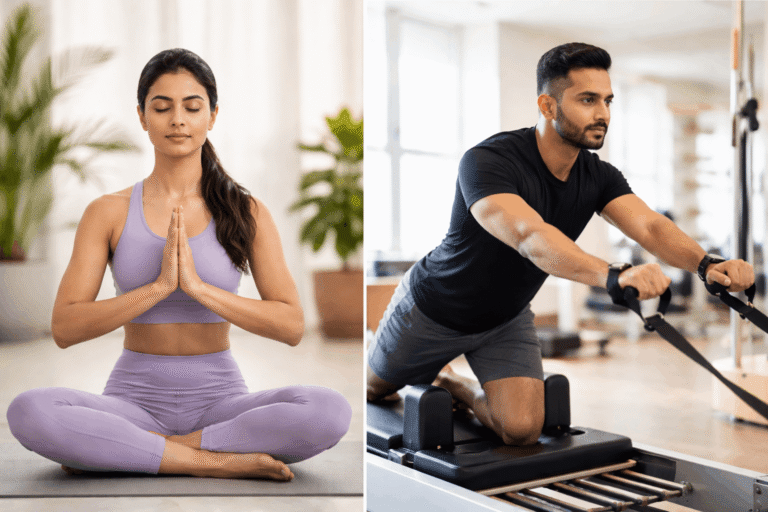
When it comes to low-impact workouts that build strength and improve flexibility, the debate around Yoga vs Pilates always comes up.
Both are popular. Both improve posture. Both strengthen the body without heavy weights. So why is there so much confusion?
The confusion exists because from the outside, they look similar. You see mats. You see slow movements. You see controlled breathing. But underneath that surface, the philosophy, structure, and training goals are very different.
Understanding Yoga vs Pilates is not about choosing which one is “better.” It’s about understanding which one fits your goals, personality, and lifestyle.
Let’s break it down clearly.
At a glance, both practices:
Use bodyweight exercises
Improve flexibility
Strengthen core muscles
Emphasize breathing
Are low-impact
But similarity in appearance does not mean similarity in purpose.
Yoga has thousands of years of tradition behind it. Pilates is a modern system developed for rehabilitation and controlled strength. The movements may sometimes look alike, but the intention behind them is different.
When comparing Yoga vs Pilates, the key difference lies in philosophy.
Yoga is rooted in ancient traditions from India. It blends physical postures with breathwork, mindfulness, and sometimes spirituality. The goal is balance between body and mind.
Pilates was developed in the 20th century by Joseph Pilates. It focuses on controlled movement, core stability, and alignment. The goal is efficient movement and injury prevention.
In simple terms:
Yoga connects body, breath, and awareness.
Pilates trains control, precision, and strength.
That foundation shapes everything else.
| Attribute | Yoga | Pilates |
|---|---|---|
| Origin | Ancient India | 20th century Germany |
| Focus | Mind-body balance | Core strength |
| Flexibility | High | Moderate |
| Core Strength | Moderate | High |
| Spiritual Component | Yes | No |
| Breathing Style | Rhythmic & mindful | Structured & controlled |
Now let’s explore these differences deeper.
Yoga dates back over 5,000 years. It is more than exercise; it is a system that includes meditation and breathing practices.
Pilates was created in the early 1900s as a rehabilitation method. It was initially used to help injured soldiers regain strength.
This difference explains why Yoga vs Pilates often feels like a choice between relaxation and precision training.
Yoga focuses on:
Flexibility
Mental clarity
Stress reduction
Flowing movement
Pilates focuses on:
Core stabilization
Muscle control
Alignment
Postural strength
If your main goal is mental relaxation, yoga might appeal more. If your goal is strengthening deep abdominal muscles, Pilates may be more effective.
Yoga generally involves deeper stretches and longer holds. It actively improves:
Hamstring flexibility
Hip mobility
Shoulder range of motion
Pilates includes flexibility but prioritizes muscle control first.
If flexibility is your top goal, the Yoga vs Pilates debate leans toward yoga.
Pilates is highly focused on the “powerhouse” muscles:
Transverse abdominis
Pelvic floor
Obliques
Lower back stabilizers
Yoga builds core strength too, especially in styles like power yoga, but Pilates isolates it more directly.
Yoga breathing is mindful and rhythmic. It helps calm the nervous system.
Pilates breathing is structured. It coordinates breath with muscle engagement to support core activation.
Breathing in Pilates is functional.
Breathing in yoga is both functional and calming.
Now let’s simplify it.
Yoga activates the parasympathetic nervous system. That means:
Lower heart rate
Reduced cortisol
Improved sleep
Slow flows and restorative sessions are powerful tools for mental balance.
If stress reduction is your priority, Yoga vs Pilates clearly favors yoga.
Pilates targets deep core muscles with precision. Small, controlled movements strengthen the abdominal wall without bulk.
If you want visible core definition and better spinal support, Pilates may be more effective.
Longer holds and dynamic flows improve overall range of motion. Yoga encourages muscle length and mobility.
Pilates improves flexibility, but not as aggressively.
Pilates was designed for rehabilitation. It strengthens the muscles that hold your spine upright.
If you struggle with:
Lower back pain
Rounded shoulders
Weak glutes
Pilates may provide more structured correction.
When analyzing Yoga vs Pilates from a sports science angle:
Yoga improves mobility and stress regulation.
Pilates improves neuromuscular control and stability.
Athletes often use yoga during recovery phases and Pilates during strength-building phases.
Both improve balance and injury prevention.
Yes—and that might be the best answer.
Many fitness professionals recommend combining both methods.
For example:
Monday: Pilates core session
Wednesday: Yoga flow
Friday: Pilates strength
Sunday: Restorative yoga
This approach balances flexibility with strength.
🔑 Key Takeaway:
Both complement each other rather than compete.
❌ Common Mistake:
Choosing based on trend instead of personal goals.
Just because Pilates is popular on social media does not mean it suits your needs. Likewise, choosing yoga because it feels “gentle” may not challenge your weak areas.
Your body goals should guide your decision—not trends.
| Goal | Yoga | Pilates |
|---|---|---|
| Beginner Friendly | Yes | Yes |
| Injury Recovery | Good | Excellent |
| Weight Loss Support | Moderate | Moderate |
| Athletic Cross-Training | Good | Excellent |
| Mental Relaxation | High | Low |
| Core Isolation | Moderate | High |
| Mobility Gains | High | Moderate |
This comparison shows that Yoga vs Pilates is not about superiority—it’s about application.
Choose yoga if you:
Feel mentally overwhelmed
Want better flexibility
Enjoy flowing movements
Value mindfulness
Yoga supports long-term stress management and mobility.
Choose Pilates if you:
Want stronger abs
Need posture correction
Prefer structured exercises
Recover from injury
Pilates builds foundational strength that carries into other workouts.
The conversation around Yoga vs Pilates often sounds competitive. But it shouldn’t be.
Yoga trains flexibility and calm.
Pilates trains strength and control.
The best workout is the one that supports your body and fits your life.
Instead of asking which is better, ask:
What does my body need right now?
Do I need strength or relaxation?
Do I enjoy structure or flow?
When chosen intentionally, both can transform your health.
Yoga is not better than Pilates, and Pilates is not better than yoga. They serve different purposes. Yoga improves flexibility and stress reduction, while Pilates focuses more on core stability and posture. The better option depends entirely on your personal goals.
Both support weight loss when paired with proper nutrition. Power yoga and advanced Pilates can elevate heart rate and burn calories. However, neither replaces strength training or cardio entirely. They are best used as part of a balanced fitness plan.
Difficulty depends on style. Advanced Pilates sessions can feel extremely intense due to core isolation. Power yoga can also be physically demanding. Restorative yoga is gentle, while beginner Pilates may feel challenging because of controlled movements.
Pilates was designed for rehabilitation and often helps strengthen muscles that support the spine. Many physical therapists recommend it. However, yoga can also reduce back pain if poses are done correctly and not forced.
Yes. Both yoga and Pilates offer beginner-friendly classes. Start slow and focus on proper technique. Avoid advanced movements until you build foundational strength and flexibility.
Yoga builds muscle endurance and functional strength, especially in styles like Vinyasa. Pilates, however, isolates muscles more directly and may create faster core strength improvements.
Yoga generally produces greater flexibility improvements due to longer stretch holds. Pilates improves mobility but prioritizes stability over deep stretching.
Yes, but keep intensity balanced. You might do Pilates first for strength and follow with gentle yoga stretching. Avoid doubling high-intensity sessions to prevent fatigue.
Most people benefit from 2–4 sessions per week. Recovery matters. Alternate intense sessions with lighter ones to avoid overtraining.
Pilates often improves posture faster because it targets deep stabilizing muscles directly. However, yoga also enhances alignment awareness over time.


Every step forward deserves a high-five.✋
Address:
Plot 21 Krishnapuram Beside Income Tax Colony Rd No 10 Banjara Hills, Hyderabad, 500034, India
Write to us at:





