
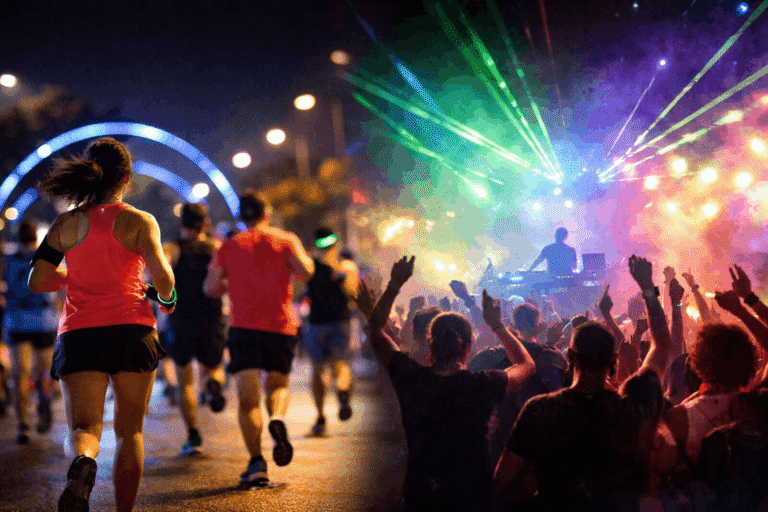
Run and Rave parties are becoming popular in cities around the world. You’ve probably seen videos online—people running together, neon lights flashing, music blasting, and then a big dance celebration at the end. It looks exciting. It looks fun. But the real question is simple:
Do Run and Rave parties mean anything to fitness? Or are they just another trend wrapped in loud music and bright colors?
Let’s break it down in simple terms.
This article will explore what Run and Rave parties really are, how they affect fitness, whether they offer real health benefits, and how they compare to traditional workouts. We’ll keep it practical and easy to understand.
Run and Rave parties combine two things:
A group run (usually 3K–10K)
A high-energy dance event at the finish line
Participants run together—often at a relaxed pace—then celebrate with music, DJs, lights, and social energy. The vibe is more party than competition.
Unlike traditional races where time and performance matter, Run and Rave parties focus on community, fun, and shared experience.
But does that translate into real fitness benefits?
At its core, fitness is about improving your body’s ability to:
Move efficiently
Build strength
Increase endurance
Improve cardiovascular health
Maintain mobility and flexibility
So the real question becomes:
Do Run and Rave parties help improve these areas?
The short answer: Yes — but with limits.
Let’s look deeper.
Running, even at a moderate pace, improves cardiovascular fitness. When you run:
Your heart rate increases
Your lungs work harder
Your blood circulation improves
Your endurance builds over time
Even if participants treat the event casually, they are still moving. And movement matters.
If someone who normally sits all week joins a 5K Run and Rave party, that’s already a positive step toward better fitness.
Cardiovascular exercise lowers the risk of:
Heart disease
Type 2 diabetes
High blood pressure
Obesity
Even one consistent event per month can contribute to overall fitness when combined with daily activity.
Movement beats no movement. If Run and Rave parties get people off the couch, they already contribute to fitness.
One of the biggest problems in fitness is consistency.
People don’t quit workouts because exercise doesn’t work. They quit because:
It feels boring
It feels lonely
It feels too hard
It lacks social connection
Run and Rave parties solve one major problem: they make movement fun.
Fun increases consistency.
Consistency improves fitness.
When people associate exercise with music, friends, and celebration instead of punishment, they are more likely to continue.
If you struggle with consistency, schedule fun movement events like Run and Rave parties alongside structured workouts. Motivation fuels long-term fitness.
Fitness is not only physical. There’s also:
Mental fitness
Emotional fitness
Social fitness
Running with others increases accountability. Dancing after a run reduces stress. Community events build emotional resilience.
Stress reduction alone improves overall health markers, including:
Cortisol regulation
Sleep quality
Recovery rates
Immune function
In that sense, Run and Rave parties contribute indirectly to fitness by lowering stress and improving mental well-being.
Here’s where we need to be honest.
If someone only attends Run and Rave parties once every few months and does nothing else, that’s not enough to build serious fitness.
True fitness development requires:
Progressive overload
Consistency
Structured recovery
Balanced nutrition
Run and Rave parties are usually single-day events. They don’t provide a progressive plan. There’s no coaching. No strength progression. No personalized program.
So while they contribute to fitness, they are not a complete fitness system.
Let’s compare them clearly.
| Attribute | Run and Rave Parties | Traditional Structured Workouts |
|---|---|---|
| Primary Goal | Fun & Community | Performance & Progress |
| Intensity Control | Often inconsistent | Structured and measurable |
| Coaching | Rare | Often guided |
| Progressive Overload | No | Yes |
| Social Engagement | High | Varies |
| Music & Atmosphere | Central feature | Optional |
| Long-Term Planning | None | Yes |
| Accessibility | Beginner-friendly | Can vary |
| Accountability | Community-based | Coach or program-based |
| Fitness Outcomes | Moderate improvement | High improvement if consistent |
Run and Rave parties are excellent for engagement and entry-level fitness. Traditional workouts are better for measurable improvement.
They serve different purposes.
Believing that one fun event replaces consistent weekly training. Fitness improves through regular effort, not occasional excitement.
A typical 5K run can burn between 250–400 calories depending on:
Body weight
Pace
Terrain
Conditioning level
Add 30–60 minutes of dancing, and you increase energy output even more.
From a pure energy expenditure perspective, Run and Rave parties can be equivalent to a solid cardio session.
But energy burn alone does not define fitness.
You also need:
Strength development
Mobility work
Recovery balance
Running mainly works:
Quadriceps
Hamstrings
Calves
Core (to a degree)
Dancing adds dynamic movement but still does not create structured resistance.
Without strength training, you risk:
Muscle imbalances
Joint instability
Overuse injuries
Plateaus in fitness
This is where Run and Rave parties fall short if they are your only activity.
Pair Run and Rave parties with 2–3 weekly strength sessions. This builds muscle and supports long-term fitness gains.
Beginners
Social exercisers
People returning to fitness
Those who dislike gym culture
Community-driven personalities
For beginners especially, Run and Rave parties reduce intimidation. There’s no pressure to be fast or strong. That psychological safety is valuable.
For someone just starting their fitness journey, that first positive experience can change everything.
Now let’s talk about the “sham” question.
Are Run and Rave parties marketed as revolutionary fitness breakthroughs?
Sometimes, yes.
Marketing may suggest:
Transformative results
Massive calorie burn
Life-changing body changes
That’s exaggerated.
No single event transforms fitness. Fitness is cumulative. It’s built over weeks, months, and years.
If someone believes one Run and Rave party will replace daily movement, they may be disappointed.
But that doesn’t make it a sham. It just means expectations need to be realistic.
Celebration after effort reinforces behavior.
This is behavioral science 101:
Effort → Reward → Repeat behavior
When people run and then celebrate with music and lights, their brain associates movement with reward. Dopamine increases. Motivation strengthens.
That psychological link makes future fitness behaviors easier.
Traditional workouts rarely include celebration. They end with sweat and fatigue. That’s fine, but it doesn’t emotionally anchor the experience the same way.
Run and Rave parties may not build elite athletes, but they build positive associations with movement.
And that matters.
The biggest benefit of Run and Rave parties might not be physical. It might be behavioral.
If someone says:
“I never thought I’d enjoy running, but that was fun.”
That sentence alone is powerful.
Because enjoyment increases adherence.
Adherence improves fitness.
Over time, people who start with fun community runs may:
Join local running groups
Sign up for races
Begin strength training
Improve nutrition
In that way, Run and Rave parties can act as a gateway into a deeper fitness lifestyle.
Run and Rave parties are not a full fitness program. But they can spark a real fitness journey.
Yes.
Alcohol may be involved in some events.
Sleep disruption if events run late.
Overexertion for beginners.
Poor recovery habits afterward.
If participants treat it only as a party and ignore recovery, hydration, and sleep, the fitness benefits decrease.
Running hard without proper warm-up because the environment feels casual. Always prepare your body properly.
Here’s how to maximize the benefits:
Train lightly in the week leading up.
Warm up before the run.
Hydrate before and after.
Add strength sessions during the week.
Sleep well afterward.
Track your progress if possible.
When integrated into a weekly plan, Run and Rave parties enhance fitness instead of replacing it.
Run and Rave parties are not a sham.
But they are not magic either.
They are:
Motivational
Social
Moderately beneficial for cardiovascular fitness
Excellent for beginners
Limited for advanced athletic development
If you treat them as a supplement to structured training, they add value.
If you treat them as your only form of exercise, your fitness progress will likely stall.
Yes, especially cardiovascular fitness. Running increases heart health and endurance, while dancing adds extra movement. However, improvements depend on frequency. Attending one event occasionally won’t dramatically change your fitness level, but consistent participation combined with other workouts can make a noticeable difference over time.
Absolutely. They are beginner-friendly because they focus more on enjoyment than competition. There’s less pressure compared to formal races. This makes them a great entry point into fitness for people who feel intimidated by gyms or structured training programs.
Not entirely. While they offer cardiovascular benefits, they don’t provide structured strength training or progressive overload. For balanced fitness, you still need resistance exercises and mobility work throughout the week.
Once or twice a month can be a fun addition to your routine. However, daily or weekly structured workouts are still necessary for long-term fitness improvement. Think of these events as bonus sessions rather than core training.
Yes, depending on the distance and how much you dance. A 5K run plus dancing can burn a few hundred calories. However, calorie burn should not be your only focus. Overall fitness includes strength, endurance, flexibility, and recovery.
Like any physical activity, there is risk if you’re unprepared. Running without warming up or wearing improper shoes can cause strain. Beginners should start slow and avoid sprinting if they are not conditioned.
Yes. Social connection, music, and movement all reduce stress. Many participants report feeling energized and happier afterward. This mental boost can indirectly support long-term fitness consistency.
They can be over-marketed, but they’re not fake. The fitness benefits are real, especially for cardiovascular health. The key is realistic expectations. They are fun events—not miracle transformations.
Yes, but mostly as active recovery or cross-training. Elite athletes still need structured, high-intensity training. For them, Run and Rave parties are more about community and enjoyment than performance gains.

Every step forward deserves a high-five.✋
Address:
Plot 21 Krishnapuram Beside Income Tax Colony Rd No 10 Banjara Hills, Hyderabad, 500034, India
Write to us at:





