
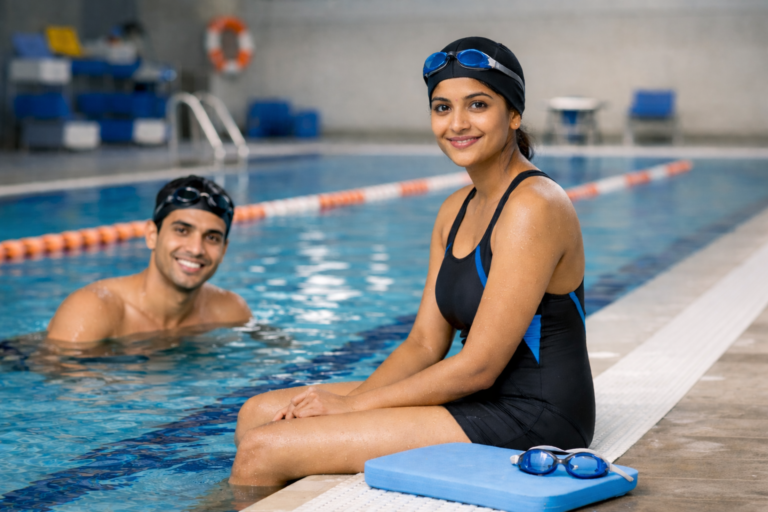
If you are nervous about stepping into a pool for the first time, you are not weak, behind, or unfit. You are normal. Many adults and teens delay swimming for years simply because they do not know what will happen once they enter the pool.
This guide is written to remove that fear through clarity.
Your First Swimming Session Explained is not about performance. It is about comfort, safety, and leaving the pool feeling proud instead of overwhelmed. You do not need to “be good.” You only need to show up.
Read this once before your session. Visualize it. Then let your body follow the plan calmly.
The biggest fear beginners have is not water—it is uncertainty.
Most pools follow a simple flow:
Front desk check-in
Changing rooms
Showers near the pool
Pool entry
Nobody is watching you. People are focused on themselves. Even lifeguards are scanning for safety, not judging skill.
Pools are usually:
Warm but not hot
Echoey (sounds feel louder than they are)
Calm once you slow your breathing
Key Takeaway:
Nothing sudden happens. There is no countdown. You move at your own pace.
Preparation does not need to be stressful or long.
Change into your swimsuit
Take your time. There is no rush.
Quick shower (30–60 seconds)
This helps hygiene and also lets your body feel water before swimming.
Put on goggles
Adjust them gently. They should seal, not squeeze.
Walk slowly to the pool
That is it. No stretching marathons. No complicated routines.
Wear flip-flops or sandals. Cold tiles can increase tension before you even start.
This is where calm begins.
Use:
Pool steps
Ladder
Shallow ramp (if available)
Let water reach:
Ankles → knees → waist → chest
Pause at each level if needed.
Before moving:
Hold the wall
Inhale through your nose for 4 seconds
Exhale slowly through your mouth for 6 seconds
Repeat 3–5 times
This signals safety to your nervous system.
While holding the wall:
Kick slowly
Move arms under water
Feel buoyancy
You are not “starting swimming” yet. You are meeting the water.
Your First Swimming Session Explained always begins with breathing, not movement.
Let’s remove the biggest myth.
Most beginners actively swim for:
5 to 15 minutes total
Broken into short attempts
And that is completely enough.
Holding the wall and kicking
Floating with support
Short swims of 5–10 meters
Pausing often
You do not need continuous laps.
Thinking you must swim nonstop to “make it count.” You don’t. Comfort counts more than distance.
| Aspect | Expectation | Reality |
|---|---|---|
| Time in pool | 30–60 minutes | 15–25 minutes |
| Continuous swimming | Long laps | Short bursts |
| Breathing | Automatic | Learned slowly |
| Resting | Feels embarrassing | Completely normal |
| Fatigue | Means failure | Means learning |
Key Takeaway:
Your body is adapting. Not failing.
This deserves its own section.
The pool wall is:
A safety tool
A breathing station
A confidence anchor
Even strong swimmers use it.
Beginners often stop:
Every 10–30 seconds
After each short swim
Whenever breathing feels rushed
This is expected.
Rest before you feel exhausted. Early rest prevents panic.
Your First Swimming Session Explained includes rest as part of progress, not interruption.
Fatigue in water feels different. It can surprise you.
Water resists every movement
Breathing rhythm is new
Muscles are unfamiliar with buoyancy
This does not mean you are unfit.
Stop moving
Hold the wall or grab a float
Focus only on long exhales
Let heart rate settle
Fatigue passes quickly when breathing slows.
Trying to “push through” tiredness. This increases anxiety.
Use this anytime:
Inhale nose: 3–4 seconds
Exhale mouth: 6–8 seconds
Shoulders relaxed
Face calm
Repeat until breath feels smooth again.
This is your safety switch.
Here is a realistic flow:
Minutes 0–5: Enter water, hold wall, breathe
Minutes 5–10: Gentle kicks, small movements
Minutes 10–15: One or two short swims
Minutes 15–20: Rest, float, light movement
Minutes 20–25: Exit calmly
That is a successful session.
Your First Swimming Session Explained is about finishing calm—not exhausted.
You may feel:
Proud
Nervous
Emotional
Relieved
Slightly shaky
Water engages both body and mind.
Emotions do not mean danger. They mean release.
What you do after matters.
Wrap in towel
Sit or stand quietly
Let breathing normalize
Warm water helps muscles relax and signals completion.
Tell yourself:
“I stayed calm.”
“I listened to my body.”
“I finished safely.”
This builds trust for next time.
Your body remembers:
The water temperature
The breathing rhythm
That nothing bad happened
Confidence grows fast when fear is removed.
Your First Swimming Session Explained is about comfort, not skill
Short swims are success
Resting is normal
Holding the wall is smart
Calm breathing is everything
You do not conquer the pool. You cooperate with it.
Yes. Fear comes from unfamiliar sensations, not danger. Once your breathing slows, fear usually fades. The goal of your first session is not to remove fear completely, but to show your body that it can remain calm in water. Confidence builds gradually, not instantly.
As many times as you need. Some beginners stop every 15–30 seconds. Others swim slightly longer. There is no correct number. Resting early and often prevents panic and helps you stay in control throughout the session.
You are not being judged. Most swimmers, including experienced ones, hold the wall frequently. The wall is part of the pool’s design for safety and rest. Confidence comes from using support wisely, not avoiding it.
No. Ending your session while you still feel calm is ideal. This leaves a positive memory and makes your next session easier. Staying too long can create exhaustion and anxiety, which slows long-term progress.
Absolutely. Many beginners never swim a full lap during their first few sessions. Short swims, assisted floating, and wall-supported movement all count as progress and help your body adapt.
Breathing in water is controlled and rhythmic, unlike on land. Your body is learning timing, not struggling. With practice, breathing becomes smoother. Slow exhales are the fastest way to regain control.
Stop immediately. Hold the wall. Focus only on slow breathing. Panic fades when oxygen flow stabilizes. You are safe as long as you stop and breathe.
Within 2–4 days is ideal. Waiting too long allows fear to rebuild. Early repetition strengthens confidence and familiarity, even if the second session is very short.
Not always. Many beginners start alone using shallow water and wall support. However, if fear is strong, a coach or instructor can provide reassurance and structure.
The real goal is to leave the pool feeling calm, safe, and willing to return. Distance, speed, and technique come later. Your First Swimming Session Explained is about building trust between you and the water.

Every step forward deserves a high-five.✋
Address:
Plot 21 Krishnapuram Beside Income Tax Colony Rd No 10 Banjara Hills, Hyderabad, 500034, India
Write to us at:





