
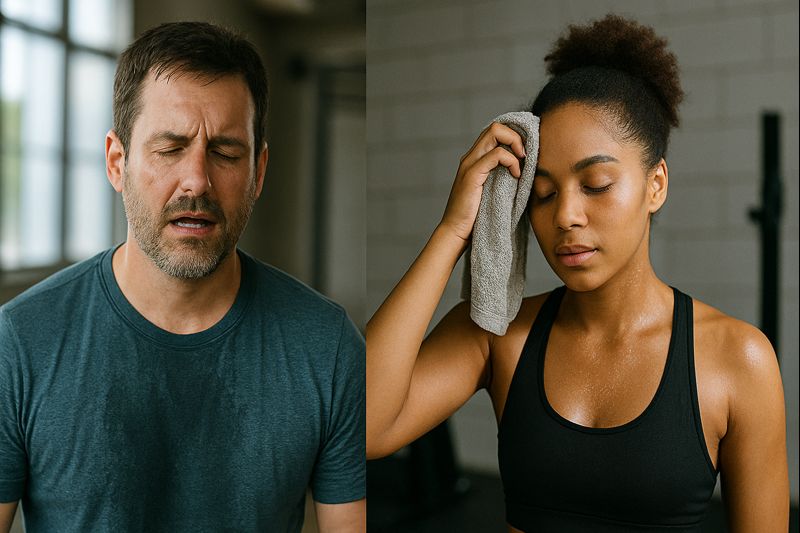
For years, many people have believed that walking out of the gym drenched means you crushed it. A soaked shirt becomes a badge of honor, a measure of how “hard” you worked. People often assume that More Sweat = Better Workout, and the more drenched they are, the closer they must be to burning fat.
But here’s the truth:
Sweat doesn’t measure effort, calories burned, intensity, or progress. It only measures how your body cools itself down.
Let’s break down why the myth that More Sweat = Better Workout is misleading—and what actually defines an effective session.
💧 What Does Sweat Really Mean?
Many gym-goers think More Sweat = Better Workout because sweat makes a workout feel intense. But sweating is simply your body’s air-conditioning system. When your core temperature rises, you sweat so you don’t overheat.
Sweating can happen when you’re:
Exercising
Sitting in a hot room
Wearing too many layers
Feeling anxious
Drinking hot coffee
Walking outside on a warm day
None of that means the activity was effective. None of it proves you burned more calories.
Sweat is influenced by genetics, hydration levels, environment, humidity, hormones, medication, and even stress.
Some people sweat a lot with minimal effort. Others barely sweat, even during tough workouts.
So if someone thinks More Sweat = Better Workout, they’ve misunderstood what sweat actually represents.
Key Takeaway
Sweat is a temperature response, not a performance indicator.
🔥 What Actually Makes a Workout “Good”?
This is where people often get confused. They assume that if More Sweat = Better Workout, then dry workouts must be useless. But that’s not true.
A great workout is defined by:
Effort (Intensity)
How hard you challenge your muscles or cardiovascular system matters far more than how much you sweat. You can easily sweat with minimal effort in a hot room, but you can also perform a heavy strength session with almost no sweat while stimulating massive muscular adaptation.
Movement Quality (Form & Technique)
You can sweat buckets during bad form repetitions—but that doesn’t mean you’re progressing. Good movement quality reduces injury risk and improves results.
Goal Alignment
Your workout should match your goals:
Strength
Endurance
Muscle gain
Fat loss
Mobility
Longevity
Depending on the goal, sweat may or may not be present.
Consistency + Progression
Progress happens when your workouts evolve—more weight, more reps, better control, improved endurance. Sweat doesn’t measure progress. But people often mistakenly think More Sweat = Better Workout because they feel more “tired.”
Common Mistake
Judging your workout by how drenched you are instead of how much you improved.
🧘♀️ Why Sweat-Level Doesn’t Reflect Workout Quality
Let’s look at why More Sweat = Better Workout is not only false—it can be harmful.
Sweat Doesn’t Equal Calories Burned
You can sweat heavily from heat alone. You can burn hundreds of calories in strength training without sweating much at all.
Sweat Doesn’t Mean Fat Loss
Fat is lost through calorie deficit and metabolic adaptation, not through sweat glands. Sweat is water—not fat.
Sweat Doesn’t Show Muscle Stimulation
Strength workouts often stimulate muscles deeply without producing extreme sweating. You may lift heavy, build muscle, burn calories, and barely sweat.
Sweat Levels Vary From Person to Person
Some people naturally sweat more. Some sweat less. Differences in sweat production don’t reflect differences in fitness.
Overemphasis on Sweat Encourages Bad Habits
Believing More Sweat = Better Workout can push people to:
Overtrain
Choose only HIIT or cardio
Ignore recovery
Exercise in unsafe heat
Wear unnecessary layers
Feel discouraged when not sweating “enough”
This mindset can quickly derail long-term progress.
🧠 Why This Myth Is Harmful
People who believe More Sweat = Better Workout tend to chase overly-intense routines instead of sustainable strength training. This leads to:
❌ Overemphasis on Cardio
You might skip strength training because it makes you sweat less, even though strength is the key to long-term fat loss.
❌ Overtraining or Injury
Chasing sweat can push you to work too hard, too often, or in unsafe conditions.
❌ Heat-Related Risks
Working out in hot environments to “burn more calories” increases risk of dehydration and heat exhaustion.
❌ Discouragement
When someone doesn’t sweat much during a session, they mistakenly feel like they failed.
The belief that More Sweat = Better Workout prevents people from focusing on what fitness truly requires: progress, effort, and consistency.
🎯 What Should You Focus On Instead?
If you stop using sweat as your fitness scoreboard, you can start measuring what actually matters.
Track these instead:
💪 Strength Progress
Are you lifting more weight over time?
Are reps increasing?
Is your form improving?
🏃♂️ Endurance Gains
Can you run farther?
Breathe easier?
Maintain pace longer?
🧘♀️ Mobility + Flexibility
Do you move better?
Do aches fade over time?
😴 Energy + Recovery
Do you feel energized after workouts?
Do you sleep better?
Is recovery smoother?
🎯 Consistency
Are you showing up 3–5 times a week with intentional effort?
That matters more than sweat ever will.
Sweat is a side effect. Progress is the goal.
The belief that More Sweat = Better Workout overshadows what truly improves your performance: structured training and gradual growth.
🔍 Comparison Table: Sweat-Based Workouts vs. Effective Workouts
| Attribute | Sweat-Based Thinking | Effective Training Mindset |
|---|---|---|
| Primary Goal | Sweat as much as possible | Improve performance & technique |
| Effectiveness | Unreliable | Highly reliable |
| Injury Risk | Higher (overexertion) | Lower |
| Motivation Source | Feeling drenched | Seeing progress |
| Measurement of Success | Sweat levels | Strength, mobility, endurance |
| Sustainability | Low | High |
| Fat Loss Impact | Misleading | Real metabolic change |
| Alignment with Goals | Poor | Strong |
| Long-Term Benefit | Minimal | Significant |
| Science Support | None | Strong evidence |
This table makes it clear why the idea that More Sweat = Better Workout doesn’t hold up.
🚿 Bottom Line
Sweat is a biological cooling response—not a measure of effort, fat burn, or workout effectiveness.
The real signs of a good workout are:
Progress
Consistency
Energy
Strength gains
Better mobility
Enhanced endurance
Improved mood
Your goal isn’t to walk out of the gym soaked. Your goal is to walk out stronger, more capable, and moving with purpose.
So next time you finish a workout—whether dry or drenched—ask yourself:
“Did I challenge myself? Did I move with purpose?”
Those answers matter far more than sweat.
The myth that More Sweat = Better Workout ends today.
🎥 Watch the reel that inspired this post:
The reel explains why More Sweat ≠ Better Workout, showing that sweating is just your body cooling down. It highlights that real progress comes from intention, form, and consistency—not sweat levels.







