

When I look back at my recent races, I realise that What My Two Half Marathons Taught Me goes far beyond pace charts and finish times. It’s a story of two very different race days, separated by a month, yet tied together by the deeper lessons they revealed — about pacing, environment, internal effort, and personal awareness.
One was warm, humid, and hilly.
One was cool, dry, and almost perfectly flat.
You’d expect the cooler, flatter one to feel easier. But both races taught me something unique. Together, they shaped my understanding of running more than any training block ever had.
The Setup: Two Races, One Goal
A month apart, I ran two half marathons that would teach me more about myself than I expected — proof that What My Two Half Marathons Taught Me isn’t about finishing times; it’s about understanding.
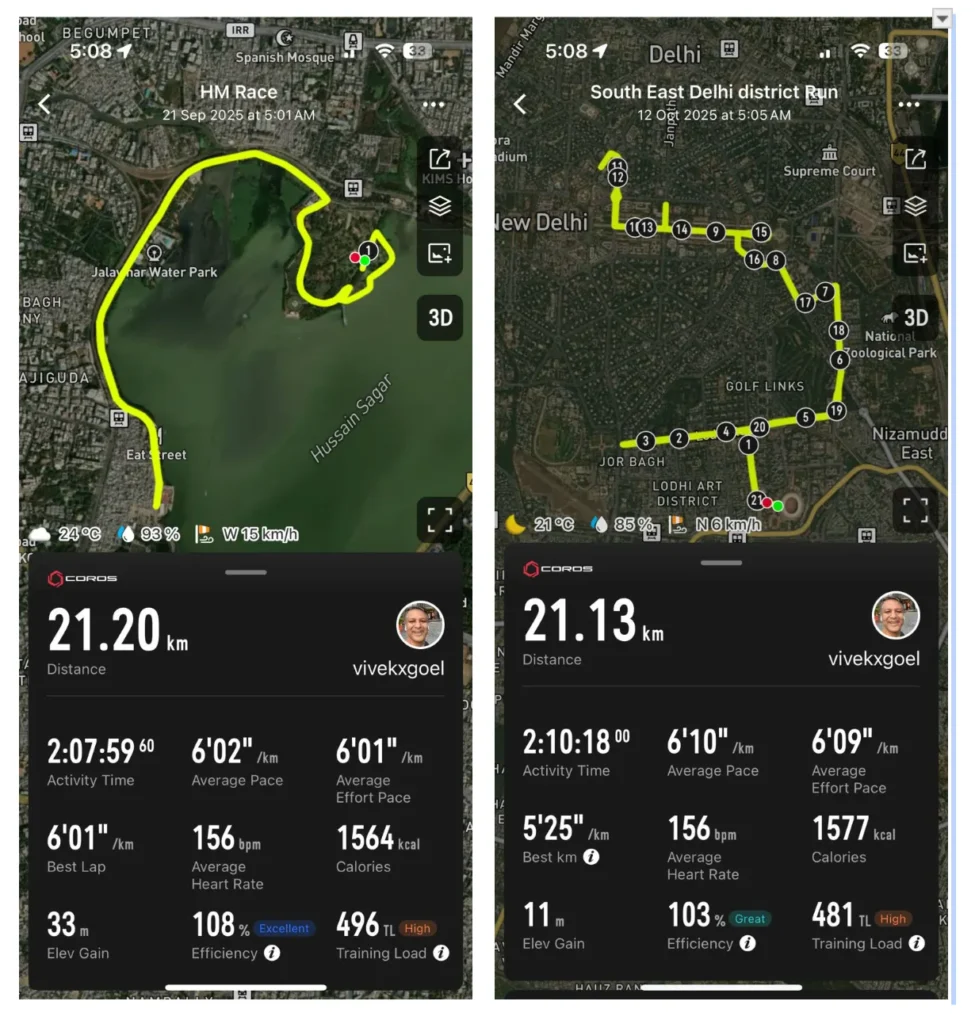
Race 1 — Hyderabad Half Marathon (21-Sep-2025)
🟠 Warm, humid, tougher weather
🟠 33m elevation gain
🟠 Notorious for late-race fatigue
Race 2 — Delhi Half Marathon (12-Oct-2025)
🔵 Cool, dry, perfect weather
🔵 11m elevation gain
🔵 Zero route challenges
Going into Delhi, I expected it to be the faster race — the kind of course that gives you “free speed.” But as I soon learned, What My Two Half Marathons Taught Me is that conditions alone don’t define a race. Your mindset and pacing matter far more.
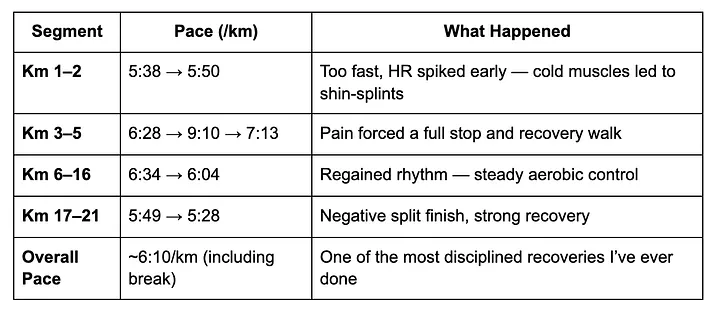
Just 2 km into the Delhi race, I made a classic mistake: I went out too fast. The excitement of a cooler day and smoother route got the better of me. My shins started to hurt sharply, forcing me to stop twice — a 3–5 minute break around kilometre 3, and another shorter one around kilometre 4.
My final time: 2:10, compared to 2:07 in Hyderabad.
On paper, it looked like a step backward. But the data told a very different story — and this is where What My Two Half Marathons Taught Me really began.
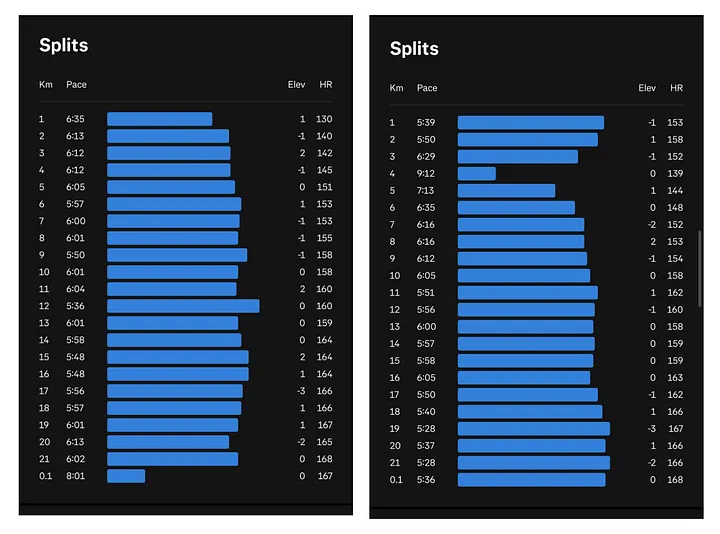
The Data: What Changed — And What Might Explain It
Looking at the numbers side by side, it seemed like Delhi was the stronger effort. Same average heart rate. More controlled aerobic time. Better zone distribution.
But I didn’t want illusions. I wanted insight.
So I compared the context, the weather, the elevation, the environmental load, and the internal effort — and suddenly What My Two Half Marathons Taught Me became clearer.
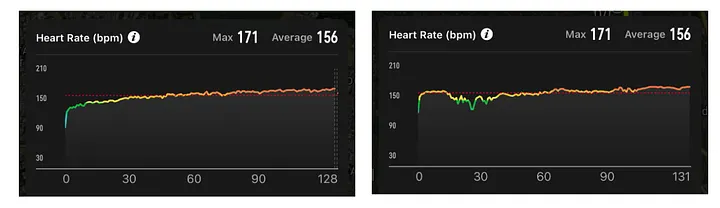
A cooler day and lower elevation can lower heart rate naturally. That meant some of the improvement wasn’t just “me getting fitter,” but the environment helping.
Yet, the rest of the progress — the part that couldn’t be explained by weather — that was real.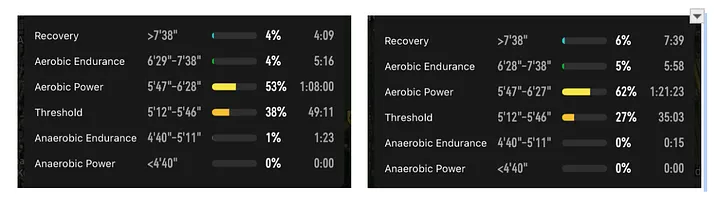
Comparison Table — Hyderabad vs Delhi Half Marathon
| Attribute | Hyderabad Half Marathon | Delhi Half Marathon |
|---|---|---|
| Date | 21 Sept 2025 | 12 Oct 2025 |
| Elevation Gain | 33m | 11m |
| Weather | Warm + Humid | Cool + Dry |
| Average Pace | Faster | Slightly slower |
| Early Race Strategy | Controlled | Too fast, led to stops |
| Heart Rate Stability | Moderate | Higher aerobic stability |
| Mid-Race Struggle | Minimal | Early breakdown |
| Final 10 km | Steady | Strong negative split |
| Overall Lesson | Control | Resilience + Recovery |
This table alone shows What My Two Half Marathons Taught Me — that performance isn’t always about pace; it’s about how you manage yourself within the conditions.
What These Numbers Actually Mean
At face value, Delhi looks more efficient.
But numbers without context can be misleading.
🏔️ Environmental Advantage
Cooler air + lower humidity + flatter terrain = easier cardiovascular load.
Around 30–40% of the “improvement” could be credited to conditions, not fitness.
And yet…
💡 The Real Improvement Was Still Mine
After the early stop, something interesting happened:
My heart rate stabilised
I stayed in aerobic zone for nearly 15 km
I finished with a negative split
I recovered mentally after breaking down early
I maintained control without panicking
These aren’t environmental advantages.
These are signs of progress — the kind that What My Two Half Marathons Taught Me made impossible to ignore.
The Splits: What the Road Revealed
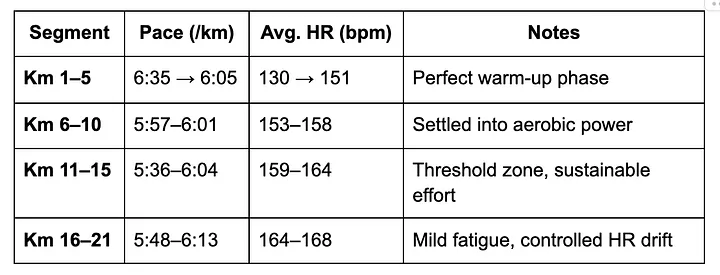
The Hyderabad race was steady. Controlled. A rising line of effort without surprises.
Delhi was messy. Disrupted. Interrupted. But then… strong. Surprisingly strong.
And this is where What My Two Half Marathons Taught Me becomes an important reminder:
A chaotic race can teach you more than a perfect one.
Hyderabad showed my endurance.
Delhi revealed my adaptability.
Both are forms of growth — both are valuable.
🟠 Hyderabad Half Marathon
🔵 Delhi Half Marathon
Six Big Insights for Runners
The deeper I dug, the clearer the patterns became. Here’s What My Two Half Marathons Taught Me in practical terms.
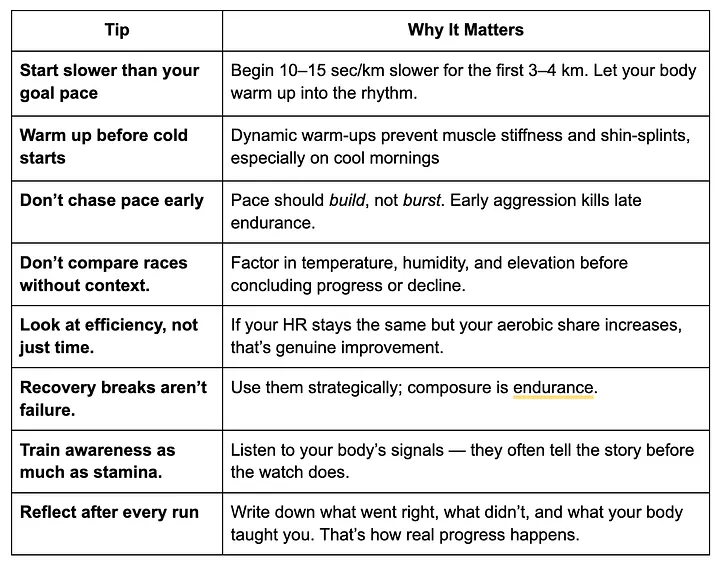
🕐 Start Slower Than You Think
A mistake I paid for in Delhi.
The first 2 km set the tone for the entire race.
Pro Tip:
Start 10–15 seconds/km slower than your goal pace. You’ll gain it back later — with interest.
🌡️ Respect Environmental Variables
Heat, humidity, elevation, wind — they change your internal effort dramatically.
If two runs feel different, it doesn’t mean you changed — the environment did.
❤️ Heart Rate Tells the Truth
Pace can lie.
Heart rate doesn’t.
Comparing HR between the two races was one of the biggest revelations in What My Two Half Marathons Taught Me.
⚖️ Pacing Discipline Comes With Practice
Delhi exposed my impatience.
Hyderabad rewarded my control.
But in Delhi, after stopping, I returned to perfect pacing — showing that discipline grows with experience, not perfection.
🔄 Recovery Is a Performance Skill
Stopping mid-race is embarrassing for some runners.
But for me, it was a turning point.
Being able to settle down, breathe, restart, and rebuild effort is an underrated skill — one that What My Two Half Marathons Taught Me highlighted clearly.
📊 Context Turns Data Into Wisdom
Your splits don’t tell the whole story.
Your watch doesn’t know the weather.
Your pace chart doesn’t understand your mindset.
What My Two Half Marathons Taught Me is that progress is a mosaic — not a single metric.
The Honest Takeaway
“Progress is rarely pure. It’s part training, part timing, part terrain, and part self-awareness.”
Delhi didn’t prove I suddenly became fitter.
It showed something better:
More awareness
More patience
More adaptiveness
More understanding of internal effort
And that’s the kind of improvement that stays with you longer than any finish time.
That’s a big part of What My Two Half Marathons Taught Me — improvement isn’t always visible on the stopwatch.
Key Takeaways for Readers
My Key Takeaway
“Every race is a mirror.
In Hyderabad, I saw control.
In Delhi, I saw resilience.
Between the two, I found my rhythm.”
I didn’t set a personal best.
But I found something more important: awareness.
That’s What My Two Half Marathons Taught Me — and that’s the personal record I didn’t expect.
Final Thoughts
If you’ve ever finished a run feeling slower than expected, don’t dismiss it. Look deeper.
Sometimes, the runs that feel disappointing are the ones quietly making you stronger.
What My Two Half Marathons Taught Me is simple:
Performance isn’t just speed — it’s composure, context, and clarity.
And when you learn to read your races this way, every run becomes a lesson.






