

Most runners begin their journey by simply lacing up and heading out the door. But very quickly, terms like tempo run, intervals, recovery jogs, threshold pace, and fartlek enter the conversation. For many beginners, these concepts seem intimidating.
This is exactly why Understanding Different Types of Runs becomes so important—it simplifies training, reduces confusion, and helps you train with clarity instead of guesswork.
At its core, How to Balance Aerobic and Anaerobic Training for Faster Times. Once you understand how these systems fuel your movement, you’ll see why runners mix different run types throughout the week. Understanding Different Types of Runs gives you the confidence to structure your mileage with purpose rather than randomness.
Any explanation of run categories begins with the energy systems that power your body.


This system uses oxygen to generate energy efficiently over long periods. It relies heavily on fat metabolism and supports:
Easy runs
Long runs
Recovery jogs
When you slow down enough to breathe comfortably, you’re training your aerobic engine. Understanding Different Types of Runs starts with realizing how crucial this engine is for 90% of your weekly training.
When you run hard and fast, your body switches to anaerobic power. This system uses stored carbohydrates and produces higher levels of fatigue. It is the foundation of:
Tempo runs
Interval training
Hill repeats
Balancing these systems is the essence of Understanding Different Types of Runs because it allows you to train both stamina and speed without burning out.
Below is a clear, beginner-friendly expansion of each run type—what it is, why it matters, and when to use it.
Zone: Aerobic
Effort: 3–4/10
Talk Test: Easy conversation
Duration: 20–45 minutes
A recovery run is the gentlest form of running and a crucial step in Understanding Different Types of Runs because it teaches you that not every workout should be hard. After demanding sessions or long runs, your muscles accumulate metabolic waste. A slow, relaxed jog boosts blood flow, easing soreness and speeding recovery.
Example:
A gentle 30-minute jog the day after a 12K long run.
Why it matters:
It keeps you consistent while allowing the body to heal. Many beginners skip this run type, but it plays a major role in staying injury-free.
Zone: Aerobic
Effort: 4–5/10
Talk Test: Conversational
Duration: 30–90 minutes
Easy runs make up the majority of most running plans. Understanding Different Types of Runs becomes much easier once you recognize that easy does not mean slow and pointless—it means controlled, sustainable effort that strengthens your aerobic base.
Why it matters:
This is where endurance is built. Your body becomes more efficient at burning fat, your muscles adapt to consistent mileage, and your cardiovascular system develops resilience.
Zone: Upper aerobic
Effort: 5–6/10
Duration: 1–3 hours
The long run is the backbone of endurance training. If Understanding Different Types of Runs had a central character, the long run would be it. Whether you’re preparing for a 5K or a marathon, long runs teach your body to be comfortable with discomfort and sustain energy for extended periods.
Pro Tip:
Finish the last 20–30% slightly faster for a progressive effect that simulates race conditions.
Why it matters:
Improves mental toughness, teaches pacing, and enhances fat utilization.
Zone: Between aerobic and anaerobic
Effort: 7–8/10
Talk Test: Only short phrases
Duration: 20–40 minutes
This is the run that boosts your ability to sustain faster speeds. Understanding Different Types of Runs involves knowing that tempo workouts aren’t sprint sessions—they’re controlled, steady efforts near your lactate threshold.
Example:
10-minute warm-up → 25 minutes “comfortably hard” → 10-minute cool-down.
Why it matters:
Tempo runs improve your ability to clear lactate, allowing you to run faster for longer without fatigue overwhelming you.
Zone: Anaerobic
Effort: 8–9/10
Talk Test: Very limited
Structure: Fast reps + recovery periods
Intervals add speed and power to your training. A crucial part of Understanding Different Types of Runs is realizing that speed work doesn’t have to be exhausting—it simply needs structure.
Example:
8 × 400 m at fast pace with 90 seconds jog.
Why it matters:
Builds VO₂ max, improves running economy, and teaches rapid recovery between bursts.
Zone: Mostly anaerobic
Effort: 8–9/10
Hills are nature’s strength training. If Understanding Different Types of Runs is about using different tools, hills are your built-in gym.
Why it matters:
Builds quadriceps, glutes, calves, and mental grit—all without needing weights.
Example:
10 × 60 seconds uphill with jog-down recovery.
Zone: Starts easy → finishes hard
Effort: 5/10 → 8/10
Progressive runs teach patience and discipline. They are ideal for runners struggling with pacing. Once again, Understanding Different Types of Runs is about learning how each style supports a different skillset.
Example (10 km run):
0–3 km easy
4–7 km steady
8–10 km fast finish
Why it matters:
Builds strong finishing ability and simulates race-day strategy.
Zone: Mix
Effort: Varies between 5–9/10
Fartlek runs blend speed and playfulness, making training more enjoyable. Understanding Different Types of Runs includes knowing that structured workouts aren’t the only way to train fast.
Example:
3 minutes easy → 1 minute fast, repeat for 30 minutes.
Why it matters:
Improves both aerobic and anaerobic systems while keeping training fun.
Not technically a “run,” but essential for Understanding Different Types of Runs because improvement happens during recovery.
Options:
Yoga, stretching, walking, or complete rest.
Why it matters:
Muscles repair and adapt. Without recovery, performance stalls.
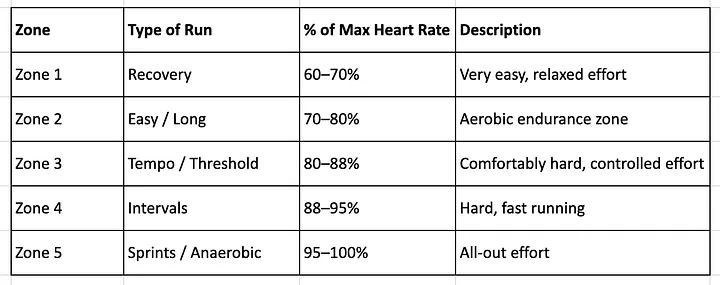
Beginners often get overwhelmed by heart rate charts and pace targets. Understanding Different Types of Runs means learning simple ways to gauge effort.
Easy/Recovery: Can talk in full sentences
Long Run: Can talk but with mild difficulty
Tempo: Only short phrases
Intervals: Talking impossible
Even without gadgets, the talk test helps you train intelligently.

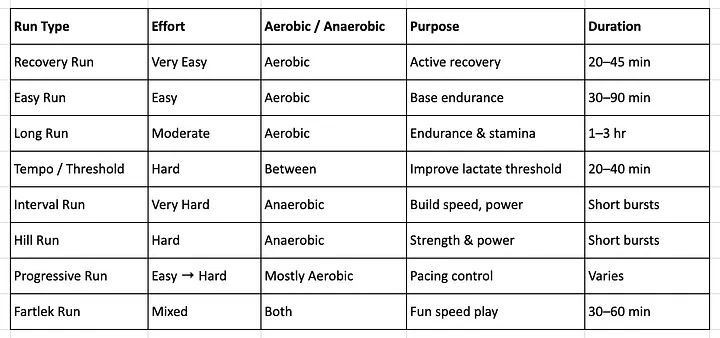
Most runners benefit from combining several run types:
1 Long Run → Builds endurance
2–3 Easy/Recovery Runs → Supports base building
1 Tempo Run → Improves sustained speed
1 Interval/Hill/Fartlek Session → Adds strength and power
Understanding Different Types of Runs ensures you create variety, avoid burnout, and progress steadily.
Running is not just about accumulating miles—it’s about using each type of run purposefully. Understanding Different Types of Runs empowers you to train smarter, stay motivated, and improve consistently. When you mix long runs, easy miles, speed work, tempo sessions, and rest, you unlock your best performance.






